I miss free food. But with the enshittification of the internet, there might be room again for more old-school restaurant reviewers using third-party expense accounts. Chubby fingers crossed!
Back in the day, I made a good part of my living reviewing restaurants. Getting paid to eat is obviously a great job. It was my passion, and I embraced it. I was one smug, well-fed puppy. Until Yelp, TripAdvisor, and their ilk brought in the crowd and ruined it for me. Eventually, I grudgingly admitted the democratic approach made perfect sense. I accepted that the crowd was generally a better reviewer than any individual, especially when that individual (me) was grumpy. But still, I miss it.
Of course, there’s still room for knowledgeable professional reviewers at big-name publications. But I’m not built for hyper competition. And anyway, I was more of a meat-and-potatoes type: guidebooks, travel magazines, newspaper supplements, and soon-to-fail website startups. Sure, I could have tried to become a food influencer – there are some great ones – but the income streams are complicated, and your integrity is always up for grabs. I want it simple: get paid to eat, with the tab picked up by a third party. Good times.
Now, with the enshittification of the internet, both the crowds and the influencers are losing trust. Maybe I can get my old gig back.
The power of positive reviewing
I was never interested in writing bad reviews. My job was usually to select and write about the best restaurants, balancing cuisines, price ranges, and captivating stories (from that steakhouse secretly serving horse to that snackbar selling a Kapsalon Viagra). The goal was to showcase Amsterdam’s culinary scene, which at the time was finally moving away from over-boiled veg and half-assed French – with only the food of Indonesia and Suriname as consistent bright spots.
If a restaurant sucked, you’d simply skip it. Very straightforward. There were exceptions, of course – a non-melted cheese tosti might be forgiven if the place had a mind-melting décor. Then, you could still mention it but with some balanced reporting (“Amazing Art Nouveau wallpaper! But stick to a beverage. For food, grab a broodje pom at the Indo-Suri-Chin snackbar around the corner. Be sure to ask Ricardo for extra sambal.”).
But in general, I just wanted to stay positive. This was important to me (and not only as tribute to my psychotically positive mother). I had previously run aground as a pop culture/cult pop journalist precisely because I had been enthusiastically positive about the wrong things. I originally got into journalism to hype the underhyped – ESG! Ween! Philip K. Dick! But when a London editor discovered I could write scathing, sarcastic reviews (which the British love), I was only ever assigned things they knew I’d hate: U2, Madonna’s children’s book, some second-rate Philip K. Dick wannabee. The work dwindled, and I moved on to other specialties – sex, human rights, or sometimes both.
Restaurant reviewing as lifestyle choice
For as long as it lasted, I took restaurant reviewing very seriously and lived by the quip: “I’m on a seafood diet. If I see food, I eat it.”
After much worshipping from afar, I also had the pleasure of getting acquainted with the legendary Johannes van Dam, Amsterdam’s iconic and iconically bitchy restaurant critic, which felt like a kind of professional blessing (though he had no patience for my happy-shiny positive ways).
While Johannes always had an assistant along when he reviewed a restaurant (a job I would have gotten a tummy tuck for), I preferred the solitude. I rarely shared my expense account, preferring to go out alone whenever possible. There was also the undercover aspect that I enjoyed – hiding my notes in a newspaper, feeling vaguely like a spy, with my own expanding girth as an increasingly effective bulletproof vest.
I did get busted once. The owner asked directly if I was writing a review, and I didn’t lie or deny. At first, I was delighted when the ordered half lobster became a whole one, and many extra glasses of wine materialised. Everything was delicious and had that secret ingredient known as love. But as I got pissed on the wine, I also got pissed off and grumpy: How dare he try to bribe me? I have my objectivity, goddammit! So, I simply left his restaurant out of the guidebook. Ha! Showed him.
Why Richard Branson is my favourite billionaire
It was definitely a case of faking it until I made it. Expense accounts, like my income, were limited. For the high-end market, I had to depend on the advice and stories of monied friends. Then Richard Branson entered my life…
He tried to break into the guidebook market with a Virgin City Guide series covering the world’s major cities. I handled the eating section for Amsterdam, was paid well, and received an unprecedented expense account that covered the dozens of restaurants I wrote about. There was even a week when I had to do two five-course meals a day to meet the deadline. I brought a friend once or twice, but mostly I was greedy – this was my chance to learn about restaurants I could never afford.
The Virgin guidebook, predictably, didn’t survive. Too much overhead went in, through, and out of my digestive system.
But thanks for making me legit, Dick.
Five days, five fondues
It’s not all glamour. There are occupational hazards.
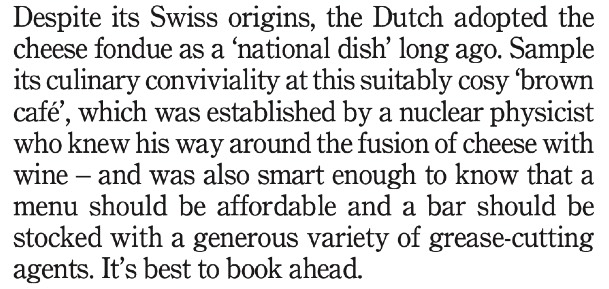
Once, due to a deadline crunch, I had to review five of Amsterdam’s best cheese fondue restaurants in five days. It felt like a dream assignment. At first…
Day one: lovely and down-to-earth, with a recipe that apparently originated with a nuclear physicist. Great selection of salads for balance. (And the restaurant still exists, largely unchanged: Café Bern – check it out.)
Day two: fancy. They even cut the bread into bite-sized pieces for you, and the recommended wine was a nippy little white delight that easily made its own friends.
Day three: still fine, technically. I found myself taking detailed notes about the cheese-to-bread ratio. In retrospect, this obsessiveness should have set off some alarm bells.
Day four: the smell of Gruyère and Emmentaler had begun to follow me home. I began to suspect that my once-discrete double chin was now drooping more downward and in danger of dipping into the bubbling cauldron of napalm-like cheese. I began hearing some ding-dongs.
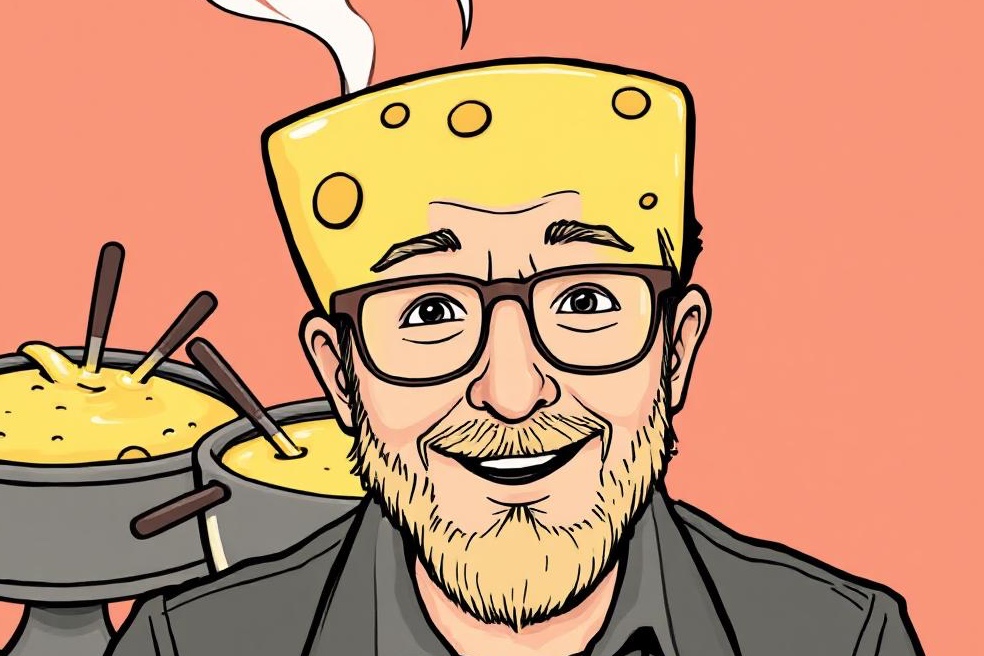
Day five: my pores were no longer excreting sweat but grease. I was strung out on stringy cheese. I was no longer reviewing fondues – I had become one. Call it method eating. Call me Al Pecorino. Robert de Cheesewheel. They say you are what you eat, but this was next level.
It was a couple of years before I went near a fondue again. But I got over it. I’m a professional that way.
Don’t mention the butter tasting
As reviewing became more crowd-sourced, expense accounts dried up. There was an ethically dubious transition period when the restaurant would pick up your tab. And as a bonus, the visit usually involved a chat with the chef – and we would usually end up gossiping about Johannes van Dam. Apparently, Johannes would still go to butter tastings in his toothless final days. Instead of imagining a man I admired slobbering on butter sticks, I’d wonder how one cleanses one’s palate between butters. By gargling with olive oil?
Of course, these conversations were always wonderful and culinarily educational (for instance, I learned a carbonated mineral water is the standard palate cleanser during butter tastings).
But you could no longer call it independent journalism.
Trust me: don’t believe the democratic hype
Gradually, the crowd took over, and I found it genuinely useful. While driving around Europe on vacation with my family, I could type something along the lines of, “shameless omnivore with fussy kids and a vegan wife” and usually find something that made everyone happy. This was the democratic ideal working as intended.
This means there could be space for a passionate person who knows what they’re talking about, has no affiliate links to disclose, and just wants someone else to foot the bill.
In other words, I’m a simple man with simple needs and talents whose time has hopefully come again. I promise to up my game and not let grumpiness get in the way of an objective view. I’ll also work harder at staying incognito; I won’t even tell my family (otherwise they might force me to bring them along and pick up their tab).
Grease: You’re the one I want… Another dream fulfilled: writing about my favorite kitchen tool for legendary Dutch architecture magazine Forum.
A knife can be handy in the kitchen. As is running water to wash your sliced fingers – or that inelegantly dropped sausage. But I believe the ultimate kitchen tool is neither a solid nor a liquid. I chose the middle path: grease. It’s the great binder of both dishes and people (and their alcohol-soaked bellies). I am not fussy on type: it can be olive oil, butter or even the often-maligned margarine. But never coconut oil. Coconut oil is a just a scam perpetrated by the Health Mafia. It’s a marketing lie. True grease is not only a tool but also a medium. It’s elemental. Astronomers recently discovered that the universe is permeated with a “fine mist of grease-like molecules” – enough to make an estimated 40 trillion trillion trillion packs of butter. So perhaps this is a sign that it’s time to embrace a more universal grease. Fuck coconut oil. Let’s get to work and package this cosmic mist […]
The US economy is generally collapsing more quickly than other economies. So it’s really a perfect time, exchange-wise, to visit New York City and indulge in what is the centre of the food universe. However it does help having a food-obsessed host to point the way. And with some luck, you can also squeeze in some more traditional sightseeing.
It’s smoking
Char No. 4 is a bar-restaurant with a passion for bourbon. Its interior is appropriately amber-hued and woody. The 19th-century row house location in Cobble Hill, Brooklyn might make it potentially pretentious. But it’s not. They serve ‘American fare with a focus on smoked meat’. And anyway, I have long trusted my food-obsessed host to regularly reward me for knowing him. He is the man who earlier introduced me to such global culinary touchstones as the ‘herring in a fur coat’ at Petrovich and the rainbow of innards that they concoct at St John.
Char No. 4 can indeed provide complementing bourbons to accompany each of their morsels of comfort food. The fried jambalaya rice balls with Andouille aioli had me feeling like I was back home in the land of Dutch kroketten and bitterballen – and I mean that in a good way and not a bad. But I am an emotional eater and I only really started to get weepy when I tasted the house-cured lamb pastrami with coriander aioli, pickled onions and grilled rye-caraway bread. By the time we were served the roasted salmon with black kale, roasted garlic and smoked pistachio-preserved lemon vinaigrette, my eyes had turned into waterfalls. It was all top nosh. On our way out, we bumped into the chef who said it was his last night before heading to California. Now it was my food-obsessed host’s turn to get overly emotional.
Borscht memories
After visiting the stacked silver boxes of the excellent and appropriately named New Museum, I was standing on the corner of 2nd and 9th in East Village waiting to meet friends for lunch at the famed Ukrainian eatery Veselka(read a great profile here). I used to eat here regularly years ago as a displaced teen and remember it always being filled with one half Ukrainian locals and the other half proto-hipsters (this was in the late 1980s before the neo-hipsters found succour in Williamsburg).
While watching the traffic going by I leaned back on a newspaper box for Village Voice and started to wonder why this weekly seems to halve in size each time I visit. Certainly Craig’s List took a big bite out of their classifieds business. But did Chowhound take a bite out of their reviewing business?
Suddenly my food-obsessed host bikes by. I experience the moment of recognition as a small stroke as he lives in Brooklyn and this just seemed like too much of a coincidence. But he just happened to be having lunch with his own food-obsessed friend a few blocks up. After I recover, he reassured me that while the rest of the hood has gentrified, Veselka remains a prime choice for lunch. (Later I would bump into him again a couple of times nearer his home while he was out getting Montreal bagels or sourcing fresh sardines from one of the excellent food shops along Court Street. This is just how it flows in a megapolis.)
Veselka’s borscht proved to be perfect and the varenyky dumplings divine. My first urge when confronted with the cabbage rolls was to just slap my face down hard on top of them and just start truffling down like a hog in heat. But to avoid burning my nose and eyes in the rich mushroom sauce, I tried to slow down by telling the story about my best friend growing up. His mother was Ukrainian. Whenever we were overly-energetic little boys, she would yell: ‘Boys please calm up; you are making me climb the ceiling.’ Oh, we would laugh. And then the next day we would point and laugh at my Dutch mother whenever she got all freestyle with the expressions of her new country – ah, the lot of the immigrant. Actually now that I think back, my friend and I were not actually to blame for our excessive energy levels. We were just still buzzing from the beet sugar in the borscht his mother had fed us for lunch.
Veselka’s borsht gave me the drive to walk very, very quickly across Manhattan towards Chelsea and finally check out the much-hyped ‘green’ (read: ridiculously over-designed but nice) High Line walkway that used to be the elevated train track that brought all the meat in and out of the Meat Packing District. Food history: it’s everywhere in New York.
The bread of Georgia
It was assumed by my food-obsessed host that we would stop off at Georgian Breadon our epic bike ride to Jacob Riis Park. Riis (1849-1914) was not a foodie but a journalist-reformer who used his camera to document slum life and invented flash photography on the way. So in a way, he can be considered a father of food photography.
As we cycled through Brighton Beach, not far from Coney Island, I was triggered by sense memories from years past: the sweat of a Russian bath house, the gentle squeak of a Nathan’s hotdog, being hypnotised by an old man slowly baking mighty pies in a pizza joint called Di Fara. This imperturbable Italian would pull out each pizza during the long baking process to give the bubbling mass a few massaging pokes with his fingers. He would then slice out some more fresh mozzarella here, and ladle out some more sauce there. Then he would put the pizza back into the oven for a few more minutes before repeating the whole process again. Meanwhile the line of saliva puddles would extend around the block. When I asked my food-obsessed host about the current state of Di Fara, he answered: ‘Now it’s just completely Disneyland.’
The Georgian bakers were however keeping it very real. In a small, hot room with a single clay oven, two men made two types of bread: a baguette-like shotipuri and a cheesy khachapuri. We opted for the cheesy to go. The older baker bagged it and passed it over a narrow counter. A small fridge was filled with a few dips and the intensely-mineral Borjomi mineral water. (And just to be clear: we are not talking about Georgia the state of pulled pork, but about Georgia the country in the Caucasus, much celebrated for their culinary skills, winemaking traditions, and being the birthplace of Stalin.)
Later on the empty and windswept beach of Jacob Riis Park with its abandoned art deco pavilion, we pulled out the crispy Frisbee-sized disk filled with salty, pudding-textured cheese. As it melted in our mouths, we all stared at each other with disbelief. Can something made by humans actually taste this good? We aided digestion by contemplating the sea, until someone tells us that this is the point where Hurricane Irene entered the city a few weeks earlier. ‘NYC has become a tropical climate, don’t you know?
A perfect Mexican. Dammit!
Perhaps my food-obsessed host had climate change in mind, when we later went to the Mexican restaurant Fonda in Park Slope. After cycling away cheese bread calories, it proved to be the perfect spot to unwind over a couple of spicy michelada beer cocktails. And dammit, the food was excellent again. But I was enjoying it less now because I was beginning to resent not living fulltime in a culinary capital. There were a few moments, for instance when picking at a huge wooden bowl filled with perfect guacamole, that I got distracted and started to unconsciously hum a happy tune. But otherwise I just complained about how Amsterdam has little range when it comes to cheap eats – Suri-Indo-Chin and, klaar, that’s it. Give me cheap Mexican! Give me cheap Vietnamese! Give me cheap sushi! Hell, I’d even be happy with a mid-range Serbian!
Finally, something real to complain about
Welcome to Williamsburg. My food-obsessed host warned us against going to Dineron a weekend, but we did not listen. We were stupid. But we had to be in the neighbourhood anyway and who can resist an authentically rundown diner in the shadow of the Williamsburg Bridge serving locally-sourced dishes? But while wedged in among the hipsters, we ended up waiting an hour for a table and then an hour for our food.
Except for a signature burger, Diner’s specials change daily – to the point that the amazingly chilled wait-staff sit down with you to write down all the specials on the paper table cloth. But in the end we were too hungry to care. We inhaled once, maybe twice, and our plates were empty. But the meals were obviously straight-up fine. It could have been quite possibly perfect on a week day. But I would never rebel against my food-obsessed host again.
Holy duck
My food-obsessed host remembered that I come from generations of duck harvesters. So it was sweet of him to take me for our last lunch to the corner of 2nd and 13th to Momofuku Ssam Bar, owned by the acclaimedKorean-American chef David Chang (a man known for his swearing and his love for offal). Their duck lunch is definitely of a whole fresh other feather. First a duck-and-pork sausage is embedded under the duck’s skin. This mutant hybridogenesis is then roasted on a rotisserie before being cut up and served with rice (which absorbed the melange of fats), duck confit (which adds yet greater depth to the melange of fats), chive pancakes (also handy to absorb the melange of fats), Bibb lettuce for wrapping (which help keep your fingers less sticky from the melange of fats), and a quartet of freaky sauces (which each combine in their own exotic way with the melange of fats).
As we made quacking and snorting sounds of delight at the bar, a brown-roasted pig buttock – a rather cute, rounded one – is served to the table across from us. It comes with a dozen oysters and rows of bowls with different kinds of fermented kimchi. Meanwhile in the open kitchen a guy is handling tripe that looks as if it came from a water buffalo. Serious stuff. A few weeks after our lunch, NY Times food critic Sam Sifton cited Momofuku Ssam Bar as his top choice for ‘For Blowing the Mind of an Out-of-Town Guest’.
I totally agreed. My mind was blown. And certainly my belly felt pretty blown on the airplane back home.
I am in a perfect position to imagine the setting of the Eel Riot of 1886: a window seat at cafe De Kat in den Wijngaert overlooking Lindengracht, a former canal that was filled in shortly after this tragic event from almost exactly 125 years ago. But sadly I cannot have a ‘perfect Amster-moment’ since the café’s otherwise stellar menu – their tostis are justifiably legendary – offers no eel-based snacks.
The enigma that is eel
As deeply enigmatic tubes, eels are 100-million-year-old slime wonders with authentic phallic mystique. A connoisseur no less than Freud spent a summer as a medical student slicing and dicing hundreds of eels in what proved to be a failed search for their sex organs. And to this day, their sex rites remain shrouded by the bottomless Sargasso, leaving scientists to hypothesize about the actual nature of the orgy of lust that climaxes the eels’ journey of thousands of miles.
Indeed, this mysterious beast generates more questions than answers. How can a decapitated eel still find its way to the nearest water? How can they so effortlessly alternate between salt and fresh water? Is it true that a ‘drinking wine suffused with fragments of its skin might turn a drunkard into a teetotaller’? And why would Sophia Loren, at the height of her loveliness, choose to play an eel factory worker in the film La Donna del Fiume?
From eating to pulling
But of course the fundamental question remains: why are they so darn tasty? Aristophanes rightly described their gustatory delight as ‘oh my sweetest, my long-awaited desire’. It was certainly easy for eels of yore to suavely slither into Amsterdam’s mass culinary consciousness by allowing themselves to be smoked and then sold from fish stalls.
People can say I’m full of brown trout, but I believe that the eel – intent on becoming Amsterdam’s spirit animal by broadening its appeal to politics – allowed itself to get caught up in a local sport popular in the 19th Century called palingtrekken (‘eel pulling’). This game involved dangling a live-eel-on-a-rope over a canal and trying to jerk it off from a wobbly boat below. Our slippery friend ‘won’ whenever a puller failed and fell into the canal.
Yes, there was an eel riot
It was this sport – one that can be argued as the evolutionary missing link between dwarf-tossing and Ajax football – that led to the Eel Riot. By that time the sport had been banned but it continued to be practiced in the Jordaan, then a staunchly working-class district. One day, when the police attempted to break up an illegal game of eel-pulling, the people decided to fight back – not for the right to pull eel, but to live life in less poverty. The army was called in to enforce the peace, with usual tragic results: 26 dead.
The newly united neighbourhood went on to organize peaceful social change. And according to Amsterdam, een lastige stad (‘Amsterdam, An Awkward City’) by JM Fuchs, the eel that sparked it all was later sold in 1913 at an auction for 1.75 guilders before disappearing from view.
Let’s take a moment to remember this working-class eel-ro.
Over at Unfold Amsterdam I just started a new column Are You Finished With That? about food and Amsterdam. At first I wanted to write a column about ‘chairs’ but I think ‘food’ gives me more freedom. After all, while we often sit down to eat, we rarely eat chairs. The column’s first episode begins with the following paragraph:
ARE YOU FINISHED WITH THAT?
Episode 1: Cafe Plop A large orange mushroom has popped up on Mercatorplein. It’s the newly-opened Cafe Zurich and it’s meant to bring more glam to the gentrifying De Baarsjes neighbourhood. Many locals already call it ‘Cafe Plop’, a reference to a deeply odd children’s TV show starring the singing gnome Plop, who deals milk from his cosy little ’shroom shack…. [READ THE REST HERE]
My feature on the 20th anniversary of the fall of the Berlin Wall (and the 60th anniversary of the rise of Currywurst) is published today in the Globe&Mail. It was a hard one to write mostly because it is such a dense and telling tale. I visited Berlin a few months after it happened and the images that still stick was of children playing in the watchtowers and the big bales of collected barbwire — forming 5-10 meter high tumbleweeds of rusting iron. So anyway, I had to leave a lot of wacky facts out of the article in the name of readability. Luckily, I have no such constraints here. Oh, and if you want more on ostalgia just check out my previous Globe&Mailfeature on the 15th anniversary….
Funniest story I heard was from my esteemed hosts Mr and Mrs Cameron (who have been living the revolution in Mitte quite a few years now…) who told me of a group of West Berlin friends who found a hole in the wall and went for a look in East Berlin. When they returned they found the hole had been closed up — they were stuck! But luckily, for them the Wall properly fell the next day.
There are a few tricks for the visitor to differentiate between former East and West halves. East Berlin has much more animated and jaunty figures in their crosswalk lights. Linguists now also know that it just takes 29 years, the time the wall existed, for distinct dialects to develop.
By 1980 an estimated 100,000 West Berliners were living life in a subculture — via cafes, communes, squats and generally radical lefty politics. (Today the most affluent of this generation support some of the largest organic supermarkets in Europe.)
You know you are buying an authentic GDR postcard by its flimsiness — and by the fact that you are overcharged for it.
And in the world of currywurst:
I had some earlier thoughts on sausage. The mighty currywurst is apparently called the “white trash plate” in Cologne and Dusseldorf but “chancellor’s plate” in Hannover. Also interesting: Gerhard Schroeder was known as the “currywurst chancellor”. And Volkswagon developed their own recipe that can only be bought in factory canteens. In 1982, the singer Herbert Groenemeyer sang passionately of his nightly desires for the mighty wurst (this YouTube clip is not for the queasy of stomach but boy does Herbert sing from the heart).
Now for something completely different:
After all that heavy street food (especially since you’ll also have to pay tribute to the Turk, Mahmut Aygun, who invented the now universal Doner Kebab here in 1972), there’s nothing like Japanese noodles. Cocolo (Gipsstrasse 3, 0172 3047584, ) serves some of the best Japanese noodle soup on the planet. Owner Ollie not only cooks but also built everything — from the furnishings to the service to the kitchen — from scratch. Inspiring! Also, Restaurant Schoenbrunn is a lovely and fancy place to dine in Volkspark Friedrichshain. Aid digestion by climbing the nearby hills which were built from the debris of WWII.
For dessert, one can pop into a baker for a Berliner (more commonly known as a Pfannkuchen in Berlin itself), the pastry JFK accidentally referred to in his “Ich bin ein Berliner” speech to half a million bewildered Berliners in 1963.
But to conclude: Mir ist alles Wurst!
Es geht um die Wurst!
Sei keine beleidigte Leber wurst!
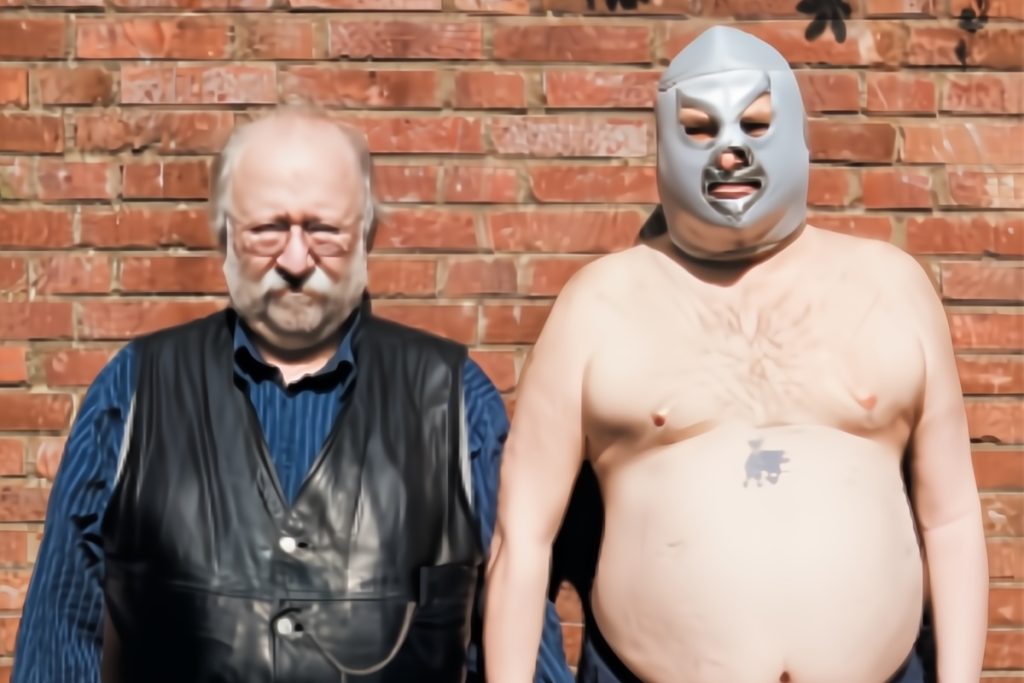
In one corner: Johannes van Dam, Het Parool’s food critic, who puts fear into the hearts of the city’s restaurateurs—he can make them, he can break them. In the other corner: Amsterdam Weekly’s Undercover Glutton—he still gets to eat in peace. We have brought them together to discuss their mutual love—nay, uncontrollable passion—for food. And indeed, it turned out that they have a lot in common besides diabetes. Whenever one mentioned a particular dish, the other would kindly provide a soundtrack of salivation and pleasurable gekreun—a near-constant backdrop of gesmekkle. It was really quite sweet. The interview took place in one of Van Dam’s favourite haunts, Cafe Luxembourg on Spui. When Van Dam enters, he asks: ‘So you want to talk about my food passion?’ He pats his belly: ‘Well, it’s only growing by the day.’ The Undercover Glutton pats his belly in response. A bond is born.
By Steve Korver, 19-04-2007, cover feature, Amsterdam Weekly.
THE BIRTH OF PASSION
What are your earliest food memories?
Johannes van Dam (JvD) I had a father who was interested in food and especially the taste of things. I remember, as a child I ate tomatoes on bread and poured sugar over it [UG moans]. Then someone suggested trying salt, so I did and that was good, too. Another memory is from when I was six or seven; my mother asked me to make her some tea, and I decided to add a lot of sugar to make it real tasty even though I knew she didn’t use it. I thought she did that out of thrift or something. She spat it out, but then explained that was because she wasn’t used to it. So I began doing without sugar in my tea for two weeks, thinking I would enjoy the sugar even more afterwards. But then I spat it out as well! I learned then that taste is very much about what you’re used to. Undercover Glutton (UG) My memory is almost the same but I never stopped with sugar! I was born premature. I didn’t want to eat, and my father fed me sugar water. Ever since, I’ve had a passion for sweet things. My mother would make brown bread-and-butter sandwiches with tomatoes and salt and pepper, and sprinkle sugar over it. My father also had a food column back then, in South Africa, along with a few restaurants. So we were brought up with good food. I just loved to eat. I had a Russian grandmother who made the best pancakes in the world… Oh, and her fried fillets of sole!
So both your parents were good cooks?
UG Yes… JvD Not at all! My mother is still alive, and she is still not. My father tried. On weekends and holidays he’d try something fancy from a very fat cookbook, but he almost always failed. I started cooking Sunday brunch for the family when I was seven or eight. Later, I cooked for my fellow students, and I’ve never stopped. I’m quite good, but I didn’t get it from my parents.
If you were a dish what dish would you be?
JvD I am a dish! They tell me so. I would be me. UG You are what you eat after all… If I was served as a dish I would feed a lot of people. The meat would be tender and rich from all the nice things I have eaten. I think a roast… JvD You are a roast. You are as big as me! UG You know, my brother is a film caterer. He also has the passion. In his will he wants to be cremated, but his last wish is to be marinated and stuffed—the whole works. His wife freaked out. I asked him if he was serious and he said yes. Sure, you need a bit of a perverse sense of humour, but after all, eating is a communal thing. That’s what I believe anyway. JvD I would be a simple peasant dish, with honest ingredients. Not many of them… something with potatoes, onions and cheese. UG Actually, I would be a terrine. JvD Why’s that? UG Because I adore terrine. I really do. I really, really do. JvD I make marvellous terrine.
Any other passions besides food and cooking?
UG Theatre. And people. Writing. Movies. Nature. I love watching nature programmes. It’s kind of odd, but it’s as if nature provides a bounty for the table. If I’m on a train, for example, and we’re passing sheep, I’m dividing them up into different dishes. Or cows, into burgers and roasts.
JvD Like a Dutch poet once said: I’m fine with sunsets as long as there is a good glass of jenever with it. I also love writing and I was doing that before I started to write about food. I also love comics, art, poetry and history. And I have a whole collection of books on hoaxes and conmen because it says so much about how people think.
At what point does food stop being a passion and start becoming a liability?
UG With diabetes. I have diabetes. JvD Yes, me too. There’s also cholesterol… UG Heart problems… JvD I am in and out of the hospital these days. Diabetes is something we share with most of our food-reviewing colleagues. Except for that scrawny little woman who doesn’t seem to like her food but writes about it anyway…
What dish since childhood have you still not got tired of?
JvD Potato puree. It should be good potatoes, well made. But, then, it’s always marvellous. In restaurants, when it says ‘served with puree’, I go: ‘Maybe I should take that’. But lots of things: kroketten of course… UG Bacon and eggs. Bacon, because it was against my religion. But I asked my dad who was eating some what it was like and he said ‘here’ and stuffed a mouthful in my mouth. I spent the rest of the day in the hot African sunshine, waiting to be struck by lightning and it didn’t happen. So then I had it everyday. The good, grilled bacon, crispy. JvD Oh, ja. That’s good. UG Maybe when you’re exposed to trying all these different types of food, no matter how exotic, you become jaded and want something simple. JvD Just like me and my puree. But for we Dutch it’s more about the uitsmijter where the meat is not fried with the egg. I have a version with pastrami, which I put on the bread and put the fried egg on top so it heats the pastrami and the fat just oozes into the bread. I can tell you it’s really marvellous. The best way you can treat both egg and pastrami. UG Where do you get your pastrami? JvDFred de Leeuw on Utrechtsestraat. He makes it from the beautiful Wagyu, the Japanese fat cow. Well-smoked and well treated. Here, they usually inject it with salt water… UG I had pastrami in New York and had to bring back whole bags of the stuff. Isn’t it pickled beef, but half-timed pickled, then roasted and smoked? JvD Not roasted, steamed. You salt it dry with the herbs and spices. Leave it for three or four days. Then you smoke it and steam it. But here, they just inject it with fluids. UG Like embalming fluids… JvD Yes, and they use lean meat. And fat is taste and succulence. It’s a pity about that, but it’s true. UG I understand we also share a passion for boiled eggs with anchovies. When I read that in one of your books, the blood drained from my face. I like a freshly baked roll. Butter. A hard-boiled egg. And anchovies. To me that is LICKKKK. JvD Anchovies are fermented and contain a lot of natural taste enhancers. It makes you drool. UG Really!
TRICKS OF THE TRADE
How did your passion become your trade?
JvD I was in journalism and suggested to a paper I start writing about food like Waverly Root did in the International Herald Tribune. My first book was based on the way he wrote his book Food. Only later did I start to review restaurants, since I was afraid that I’d be recognised and that it would make it impossible to write an objective report. But later I learned, if you have enough experience, it doesn’t matter. A bad cook will stay a bad cook no matter if you are there or not. Same with a bad waiter. Because you aren’t judging mistakes but the level someone is working at. And a mistake is a mistake. The level always stays the same. UG I just started two years ago. I wasn’t the first choice but… JvD They scraped the bottom of the barrel and there you were? UG Yes, pretty much. Well, I had been porpoising in and out of horeca for a long time. I’ve worked everywhere from a food-freezing factory to fancy digs. But I do love food. So I was given a chance and it worked out. But I’m a newcomer.
How do you prepare before going to a restaurant you’re about to review?
JvD The first thing I do is choose a restaurant. Usually, I take a kind of restaurant that I haven’t reviewed the week before. Not two Italians in a month, not two expensive ones in a row. If it’s a very specific cuisine—like this week, I did a Vietnamese—I just take out my Vietnamese cookbooks and keep them handy to check names and so on. But usually I don’t prepare very much. I used to use them more before, when I didn’t know everything like I do now [laughter]. And I always pack my own knife. A very sharp one. There were Americans in a restaurant I was eating at once. We were all eating steak and they asked me why I used my own knife. I told them: just look at your plates—they all had a red pond of liquid on them—and mine was completely dry. My juice was still in the meat and therefore much tastier, while they ripped the meat apart. It’s very convincing. UG I do what I call a flyby. I target the place. I go past and look at the menu and see if you’ve been there. I look at the numbers you gave and when you were there last. JvD I find it a pity that I can’t do that.
What’s the difference in approach for you two?
JvD I always go with an assistant who has booked the table for us. He goes in first. Once, he got seated at the worst table—against the wall and not by the river—at Excelsior. Then I showed up and they panicked and wanted to put us at another table. I said it was fine, but in the review I recommended that readers should reserve under my name or Freddy Heineken’s. A little humour is important. But these things should be mentioned. My assistant and I always order two four-course meals so I can taste them all. You need that many to be impartial and to rule out the mistakes. I once had a cake made with bad cream. It was made by an assistant who hadn’t tasted it. But I didn’t even mention it in the review because otherwise the restaurant was perfect, and mentioning it would have made the review too negative. It was just a mistake. It shouldn’t have happened. But it was not a mistake in the attitudes or the level they were cooking at. UG There are many gremlins in horeca to be sure… Well, I’m different. I’m totally anonymous. And to have a private life is great—you can misbehave. But one side of me would love to have people running in fear and trembling when I walk in. JvD [laughs] But it’s not fun. I would much prefer to be anonymous. I once even asked the make-up artist who did Van Kooten & De Bie to try to change me into someone else. But he wasn’t able to. But then there’s The New York Times’ Ruth Reichl, who wrote a book about taking on different personae to review restaurants. Anonymity is very important in New York City. There’s even prices on the heads of some reviewers—up to twenty-five thousand dollars for just a picture. But she says if she doesn’t put on a disguise the restaurateur will get his friends to sit nearby and praise the meal loudly. Well, sorry: you’re an idiot if that makes any difference to you. They can’t suddenly get a butcher with better meat. They can’t make another soup for you because there’s no time. That’s why I always take dishes that I know they had to prepare beforehand. Also dishes of different foodstuffs and techniques, so I get the full picture. Once in a two-star restaurant, I received a mixed seafood starter and there was just so much of it. So I described it in detail so they’d have to serve the same to future customers. They don’t do that kind of thing anymore. At 11 they gave me more than the table next to me. Even Paul Witteman, who is much more famous than me, got less—I joked to him that obviously he wasn’t famous enough. Then I went to the kitchen and saw that all the plates had this tiny amount. So I took a point away. They weren’t happy with that but if you give me something extra, I take something extra. I also hate it when the owner pushes his own wines, promoting his own tastes. I hate that. Rot op, I think—a gentleman’s translation of ‘fuck off’.
How do you deal with the pressure to be ‘right’?
JvD Ah. Well I try to be. I work very hard, so I always check everything. I do make mistakes but, now, rarely. Because I know a lot depends on it. If I write a bad review it’ll certainly hit hard, if I write a good review it’ll hit them, too. I know it’s a responsibility and I take it very seriously. I’ve been accused of being wrong a lot of times, but it’s always nonsense. It’s usually from people who don’t know anything and who are regular customers in a restaurant and don’t want to be called a moron and be told they eat shit, yet they love to eat shit and just go back for another portion of shit. I’m telling them they eat shit—and they do. UG I let the readers know it’s a personal observation. It’s like you learn kitchen forensics. The plate arrives in front of you. First you leave the garnishes aside (they just take up space) and look at the actual products. Where are they from? Are they from Hanos or are they from Aldi?
Is it dangerous to get to know the culinary players in town?
JvD I have one good friend who’s a chef, but I have never reviewed his restaurant. The rest are acquaintances. They act like friends but they aren’t real friends. Sometimes it results in a fight. Like Joop Braakhekke from Le Garage who started lying about it. Once I said: ‘This is shit.’ And he said: ‘Oh yes, it’s shit and actually we did not want to give you this dish, but you asked for it.’ Then later, he said: ‘Oh, he just came here one time and he thinks he can pass judgement.’ I had been there ten times. And he admitted it was shit and now it’s me that’s shit. Well, he’s a lying bastard—but now we’re like friends again. UG I’ve been asked to play him in a strange movie this year. I get to cook a human being.
And that’s a dream of yours, isn’t it?
UG Yes, it is.
So what shows a restaurant’s mettle?
JvD One thing I always take is a crème brûlée. In one way it’s a very simple dish, but it can be ruined in hundreds of ways—and usually they are ruined. It says a lot: the differences in very simple dishes like that are very obvious. I had the worst one of my life about a month ago: the cream came from a pack with clotted sugar on top, not caramelised. And people like it, apparently. But some people are lost forever [laughter]. Potato puree can also tell a lot. But it starts with the bread: if they bring hard butter you know they just don’t have any consideration for the way we consume. Sometimes it’s even worse— you can see a layer of butter and there’s another layer under it. You can do archaeology, and see they top up the butter every time and the bottom layer is very far gone [laughter]. Once I discovered that in a very expensive restaurant which was owned by one of the big criminals connected to the one who’s now on trial. But I had to state it in the review.
Which place was this?
JvD You know I’m not one to tell. But he’s in jail now—and the cook definitely should be! There should always be a balance— between sweetness and acidity. That’s very important. I wrote about The Dylan last week. It’s one of the most expensive places, and the cook did not know anything about the necessity of adding acidity to, for instance, fish. If you don’t, it’s flat. Just a splash of lemon juice, wine or vinegar adds tremendously to a fish dish. And then you pay seventy euros for a four-course meal and it was rubbish. It was just so sleep provoking. He also deconstructed some dishes as well—took them apart but then didn’t put them back together again. Like a timepiece, it was all the separate elements, but it didn’t work. It happens all the time. They want to be fancy and modern. They take things from better chefs who have invested, like Ferran Adria in Spain. He deconstructs. He invented that whole thing, and they try to imitate him and they just cannot do it. One chef took things from Adria, changed them, and from a very clever idea made complete rubbish. And he had three stars! It’s because Michelin keeps on advocating things like that—it sells tyres I guess. But I’m getting tired of it. UG This gentleman is a gourmet. I’m a pig. A gourmand, because I like to eat. And sometimes I eat pure rubbish. But I like chocolate mousse. If there’s chocolate mousse on the menu, I will order it. JvD It’s like my creme brulee. There are about four or five ways of doing it right and hundreds of doing it wrong.
What’s the biggest faux pas a restaurant can make?
JvD I once had spoilt liver. Liver that was so far gone that it seeped through the fork. UG RRRGGGHHHHH!!!! JvD Can you imagine that? It was green. Awful. I must say the cook was fired on the day my article came out. Later, everyone thought: ‘Van Dam has such power!’ But later, I heard that the managers from the company—Krasnopolsky, a quite large company—had wanted to get rid of the cook for a year but couldn’t get permission. So they were, in fact, grateful… UG My bane is getting served vegetables from the day before. And they bullshit me that it’s fresh. JvD Happens all the time. UG And second-time hashed-up potatoes—and the idea of having to pay for it! It’s just an attitude. A lackadaisical attitude. Amsterdam restaurants need to get over that. JvD The problem is that most Dutch accept this shit. As long as there is a ribbon around it, they’ll eat shit. I have a beautiful drawing by Yrrah, the cartoonist, where, in the background there are four or five ladies eating cakes and in the foreground, there’s the cook in the kitchen and he’s decorating the cakes by squeezing a dachshund. Terrible! That’s why a lot of restaurants can go on doing that. We have a task to prevent these kinds of… UG Outrages! JvD Then there’s fried potato. What they do is put a little paprika powder in the pan and a bit of fat and just mix it up with some boiled potatoes and heat it a bit, so it looks like it’s fried but it’s not all. UG And crust is very important! JvD There is a lot of cheating in the kitchen. There are even books that tell how you how do it. I’ll fight that to the death. UG To the revolution!
Power—how much do you actually have? How do you deal with it?
JvD Well, it’s not my idea, but some of my colleagues—and politicians—tell me that I’m the only journalist with any real power. I can make a restaurant close or stay open. There was an Indonesian restaurant with only two or three tables… I wrote about it and then it was sold out every night. The owners had put all their money into it, and thanked me for giving them a chance at a pension. But I take it very seriously. I’ve never cheated. Never been bought. UG Well, I’m definitely smaller-scale. Sometimes I do come by a place and think they need a boost and then I’ll write it—and if there’s a positive reaction, great. I found a great Turkish place, Temiz Slagerij, with grilled chicken. Their rotisserie attracted me as if it was that grand wonder-like monolith from 2001: A Space Odyssey. I wanted to do a dance around it and let everyone know.
Ever felt the urge to start a restaurant and let others make a judgement?
UG Absolutely not. JvD No. I’ve been offered and thought about it, but no. Also, now there are restaurants that weren’t there ten years ago that are almost the way I’d like them, so there’s less of a need. Anyway, I’m a bad employer and I’m not really an obedient person. I can’t stand people who think they are much better than I am. If I had to serve them I’d send them away crying into the street. I can’t do it. But I do give advice to restaurants. Freely. But that’s it. UG Once there was a stage when I thought I’d love something by a beach with a patio, a barbecue pit and contact with the fishermen, and a tomato patch with a few herbs growing. You’d be able to get lovely grilled fish, a delicious salad and a cup of nice wine—nothing fancy, but drinkable. With live music and dancing after dinner. Really simple. But again: no. JvD I just reviewed a little place, Gartine on Taksteeg. They are open for breakfast, lunch, high tea, but no dinner—they close at six. They have a big garden and a greenhouse in Almere Haven where they grow all their vegetables and fruits and herbs. Everything organic. Darling couple. Simple place. I imagine it was their dream—like I had, like you had. Marvellous.
THE AMSTERDAM SCENE
So what does Amsterdam have going for it?
JvD Variety and quality. Also cuisine. Good dishes. You can get shit, of course, but it’s our task to tell people where they should go and where not to go. That’s why I detest all those newspapers and magazines that only review the good ones. So you don’t know which ones to avoid. I always give tips on how the cooks can improve. I never only say: ‘This is niet lekker.’ I always say why. UG I agree about variety. I was brought up in Africa with a limited amount of exposure to cuisine. And Amsterdam is a nexus point. You got your variety, quality but also your lousiness in a small village. JvD ‘A cosmopolitan village,’ is what I always say.
What about cheap variety? You’ve got Chin-Indo-Suri but that’s it. Where’s the cheap Vietnamese?
JvD Well, that Vietnamese I just reviewed is cheap. The small pho is eight euros fifty and is enough for a meal. You can get four steamed spring rolls with shrimp for four euros. And they’re perfect.
What’s missing in Amsteram?
JvD It’s changed somewhat but I the French- and Belgian-style brasseries where you could get a good meal cuisine bourgeois. Here it’s shit or fancy—which can still be shit.
JvD It’s quite posh. But it comes close. I’m very happy it’s there because it sets a standard. There’s also Cote Ouest and the French Cafe. It’s getting better.
How about places like Harkema and Dauphine?
JvD That’s too fancy. Just like Cafe Amsterdam. It’s too Dutch, which means they are skimping on everything. It looks like a French menu but it’s actually managerial. It’s not the cook but the manager who decides. UG It’s a cost-effective menu. JvD Very cost-effective. Well, all menus should be cost-effective, but the priority is that there’s enough and it’s very tasty. But these places are just fancy. The names are fancy, the dishes, the surroundings are fancy—or modern, or whatever they are. The food remains mediocre at best. UG I miss food courts like they have in Paris or Berlin, with a variety of meat you can buy it by the ounce. Quality stuff from all over Europe. JvD We used to have that at De Bijenkorf, but they thought it was too expensive. The manager who did the cheeses went to Albert Heijn. We do have little shops and markets, but no food halls. That would be a good thing. Or a market like in… UG London… JvD Or Barcelona. Or better supermarkets. In Belgium, the supermarkets are much better quality. But here, no.
What kind of local places do you return to time after time?
JvD You want our secret addresses? Le Petit Latin. It has a French cook preparing Provençal food. It’s really quite simple, in a cellar just around the corner. Also Bordewijk. And a few Indonesians. But usually, I cook myself. UG One of my favourites is New King. JvD Also one of mine—simple and always good. There’s a review of mine hanging on the wall. UG Me too! I also love Tasca de Lisboa. That does Portuguese chicken piri piri. I love to eat with my fingers, to pick up a whole grilled chicken and… JvD Ja! UG And of course TjingTjing, but I’m biased because it’s a friend. But I think he’s good because I see what he does and he’s finicky. Everything has to be cooked to the moment. JvD I love that. I love cooks who are finicky. UG The vegetables begin raw and need to be cooked then, at the moment. Also potatoes—I’ve helped out grating rosti till my fingers bleed.
Most memorable Amsterfood moment?
JvD Well, the liver was very memorable. But you want something positive don’t you? Hmm, that’s very hard. It’s like asking a parent which one of their children they prefer… UG I’d have to choose a bit from every special place to make a composite. It’s like who’s your best friend. Your best friend is a group—a composite of all the people you love.