Tag: Architecture

  • Writing about architecture is like dancing about architecture

    Writing about architecture is like dancing about architecture

    I learned about architecture by writing about it for people who knew little about it. That turned out to be great training – until I started writing for architects themselves. Good people, but like many professionals, they’re sometimes overly attached to their fancy words. This gobbledygook, as it turns out, is catching. And it’s also, mostly, beside the point: buildings end up speaking for themselves.

    The old line goes, “writing about music is like dancing about architecture.” It means you’re wasting your time trying to sum something up with mere dumbass words. The phrase likely gained popularity among musicians annoyed at critics trying to sum everything up with their dumbass wordiness.

    This view is often true. Why overthink it? If the music rocks, it rocks. If it grooves, it grooves. If you feel it in your loins, you feel it in your loins. What else matters?

    When I first heard the quotation, the credit went to David Byrne. But it’s actually been attributed to everyone from Laurie Anderson to Frank Zappa. A version of it, “writing about music is as illogical as singing about economics”, first appeared in print in 1918. So, it’s been around and has mutated, like a good folk song. 

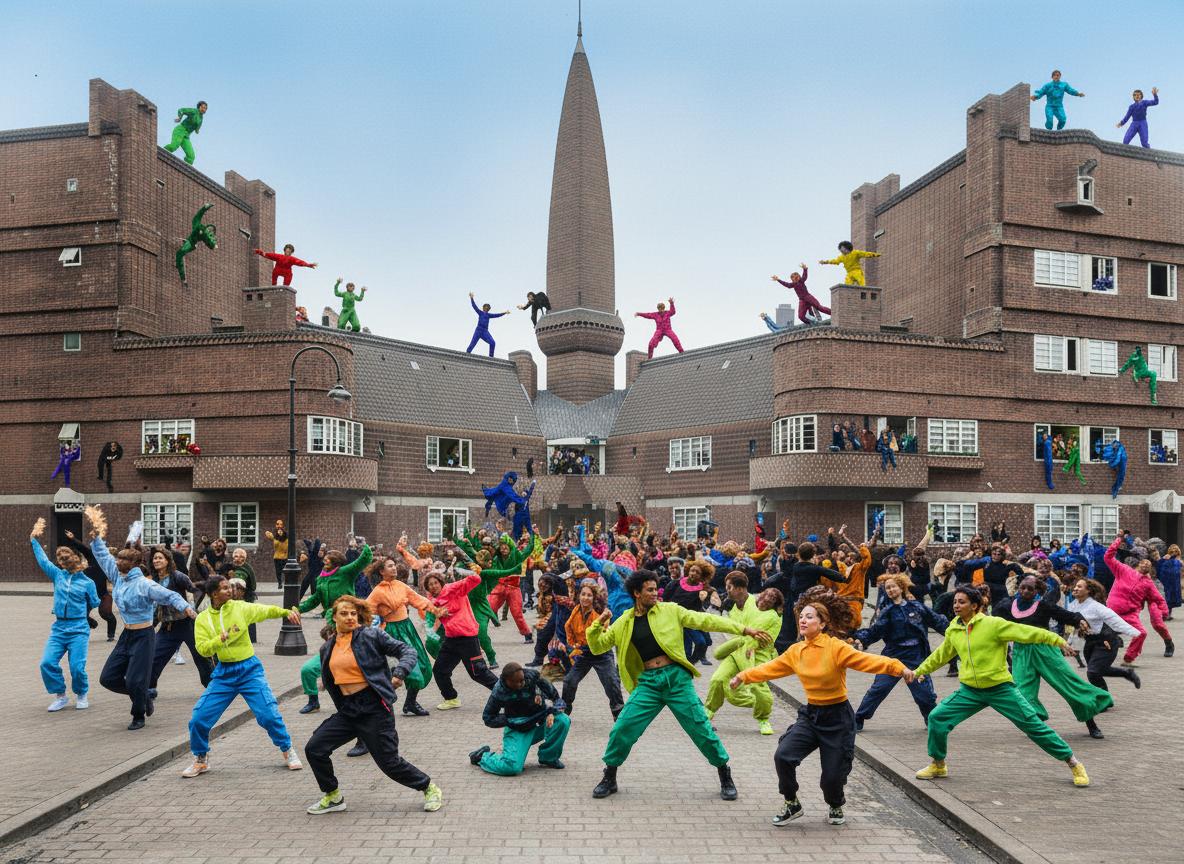
    The music critic Robert Christgau hated the expression. His response: dancing is usually about architecture. “When bodies move in relation to a designed space, be it stage or ballroom or living room or gymnasium or agora or Congo Square, they comment on that space whether they mean to or not.” 

    Not bad for mere dumbass words.

    And the phrase actually blames the wrong thing. Words don’t fail music. Jargon does.

    The drive to gobbledygook

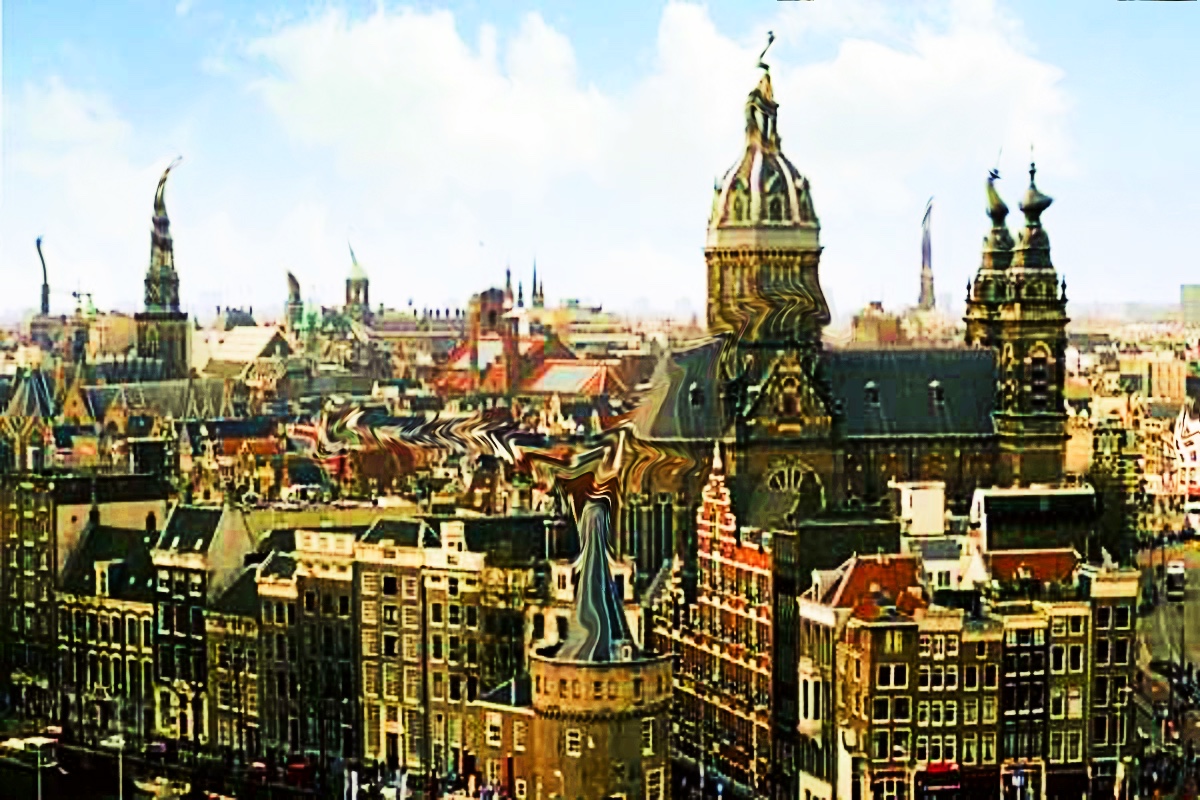
    In Amsterdam, writing about architecture meant newspapers, magazines, and city guides – writing for people who wanted to learn about a new city through the stories behind its buildings. Cutting the jargon, avoiding boring shit, and getting to the thing that makes someone stop on the sidewalk, look up and around, and hopefully go, wow. And perhaps wonder: They built all this on bog?!?

    Read: ‘Bogs, beer and business sense: 
    A short history of Amsterdam architecture

    None of these stories required a glossary.

    When I started writing directly for architects – websites, project proposals, press releases, profiles – I assumed they’d want the same thing. Clarity. Accessibility. Sentences aimed at the people most likely to hire them.

    After the first draft, the jargon would often creep back in. Terminology that made perfect sense within the discipline but sounded like gobbledygook outside it. Clients would re-introduce phrases like “a building’s program” rather than directly stating what the building is used for, whether it’s a hospital, home, morgue, cinema, or mixed-use (morgue-cinema). 

    They would try to sneak in “activated frontage” instead of just saying they want to create a lively street level. And what the hell is a “parti”? It sounds like misspelled fun. 

    Even MVRDV, which build amazingly ambitious, crowd-pleasing buildings, seem oddly determined to baffle a mass audience with their words. In one of their (many) manifestos, an “activator” generates “inhabitable surfaces” that “stimulate activities”. Don’t they just want their buildings to be fun? And shouldn’t the term “activator” have stayed in the shampoo commercial it escaped from?

    Expertise makes you a worse communicator, not a better one.

    The curse of knowledge

    I’m not out to pick a fight with architects. Full disclosure: I just wanted to see how far I could push that “dancing about architecture” phrase. It’s a conceit. And we writers love a good conceit almost as much as architects love a good parti.
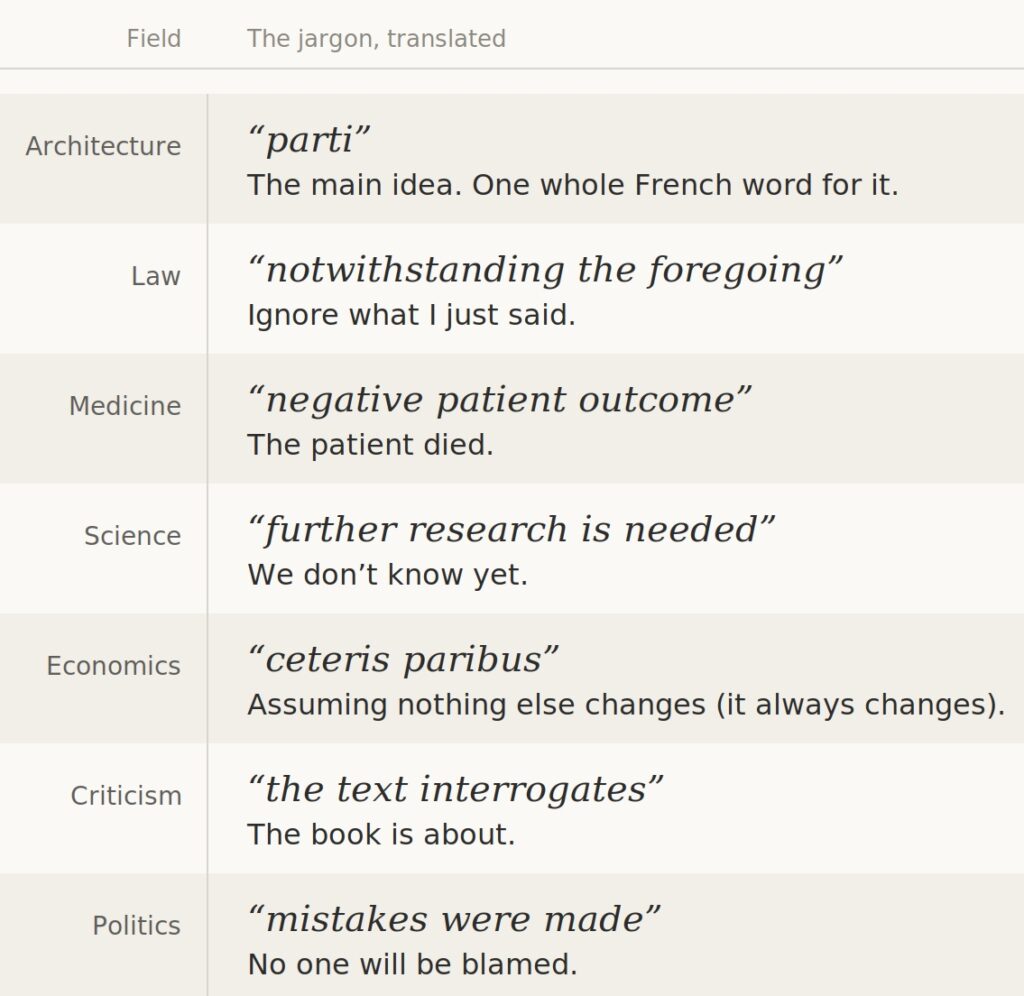
    A glossary of jargon translations from various fields

    We’re all guilty of this: lawyers writing in legalese that other lawyers can’t even followdoctors writing patient records that don’t meet basic readability standards and scientists writing their supposedly “plain-language” summaries while spewing a wall of jargon. Writers are no better: Conceit. Voice. Arc. Please shoot us: liminal

    There’s a name for this. Economists identified it in 1989 and called it the curse of knowledge: the better you understand something, the harder it gets to remember what not understanding felt like. Expertise makes you a worse communicator, not a better one. So you end up writing – haplessly – for the approval of other experts. The research is blunt about this: jargon works less as a means of communication than as a status badge within a club.

    And those are two different crimes wearing the same coat. The curse of knowledge is an accident:  you genuinely forgot what confusion feels like. The status badge is a choice: you know exactly how confusing “activated frontage” sounds, and that’s the point. One you forgive. The other you don’t.

    Admittedly, architecture may have it worse because the peer audience is so visually sophisticated and the vocabulary so well developed that staying within it feels not just natural but correct. And that’s great when they’re amongst themselves. But the people who commission, fund, inhabit, and fall in love with buildings are rarely other architects. Yet most architectural communication assumes they are.

    Architecture is way too important to leave to the architects.

    And the longer I write for architects, the more I unconsciously use their fancy words myself – even parti. I catch myself writing “program” without flinching. “Spatial experience” without irony. I try to catch these strays and castrate them. But I’m not always sure I do.

    Oh, the curse.
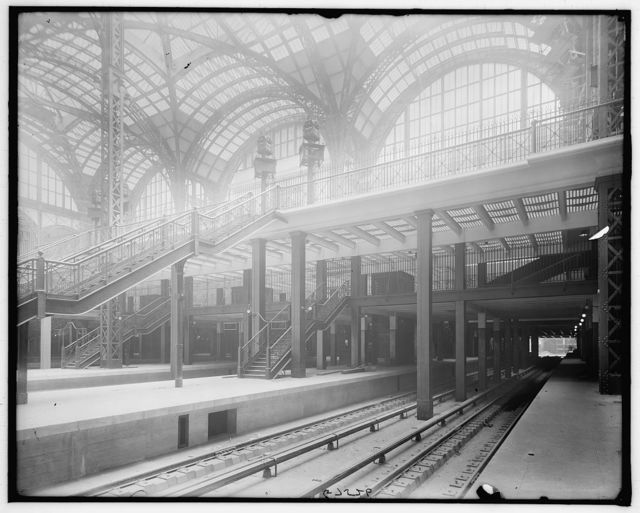
    Image of the former Pennsylvania station.

    A counter tradition

    Happily, there’s another path. Writers like Ada Louise HuxtableReyner BanhamJonathan Glancey – and closer to home, Bernard Hulsman – built careers translating architecture for readers who’d never heard of a piloti or a datum line, and in doing so shaped what got built and what got saved. When New York demolished Pennsylvania Station in 1963, Huxtable’s outrage helped galvanise the preservation movement that, a decade later, saved Grand Central Terminal and countless buildings after it. Architecture is way too important to leave to the architects. 

    It’s not just architecture, of course. Any profession that mistakes complexity for authority does the same – politics loudest of all.

    Heavy buildings

    Christgau had a point bigger than he probably intended. If buildings, like dancers, comment on the space around them, whether they mean to or not, then jargon was never really the disease. It’s the smokescreen – the thing architects can control. What a building actually says, they often can’t.

    As I learned from Amsterdam, buildings tell stories – and the clearer you tell them, the harder it gets to hide what a building is really for. Usually that’s harmless: a morgue, a cinema, the occasional morgue-cinema. Sometimes it’s not. In trying to understand the complexities of post-war ex-Yugoslavia, I wrote ‘Arkantecture: A Field Guide to Serbian Gangster Kitsch’, centred on the pink marble mansion of warlord Arkan: phallic cupolas, small gun-port windows, a ground-floor bakery, and enough local gossip to make a cab driver very careful about what constituted a safe shooting distance. 
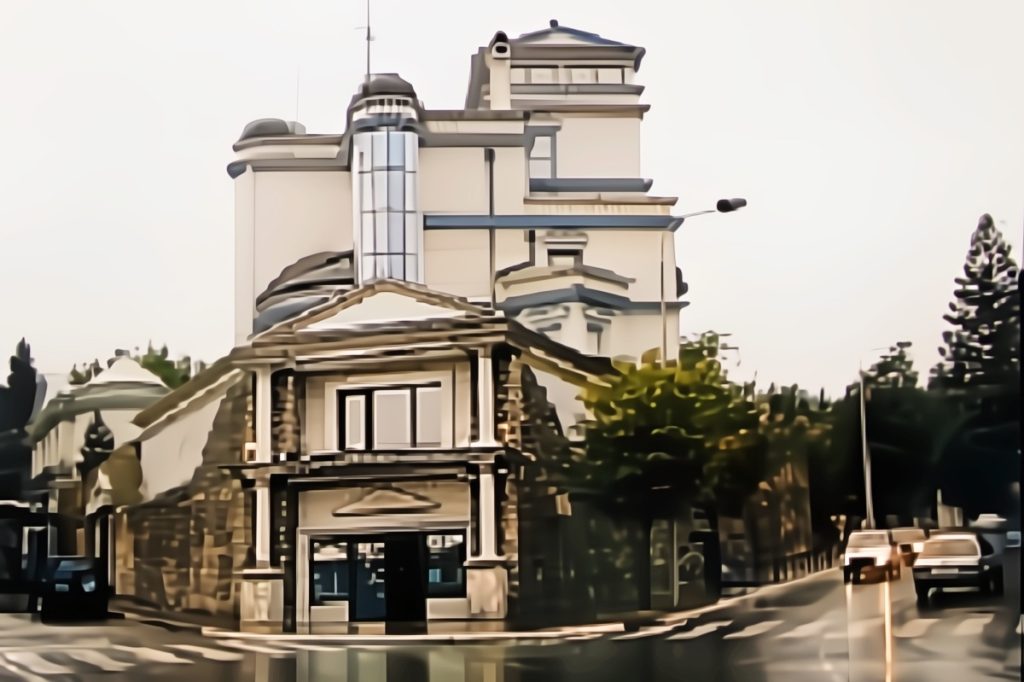
    A picture of Arkan's house in Belgrade, Serbia

    This was a building belonging to a man on Interpol’s most wanted list for a decade – yet, like a lot of architecture, it screamed: “Look at me!” The difference is what it’s asking you to look at. Arkan’s tower was architecture as self-mythology, as nationalist propaganda, as what happens when kitsch and psychosis share a floor plan. Better Homicide and Garden. Architecture has always been capable of carrying the worst of us as easily as the best, sometimes in the same building, sometimes next door.

    The Soviet Space Age makes the same point on a larger scale. The Soviets built trippy, idealistic cosmic-kitsch – spaceship sanatoria, bus stops like landing craft – that still look like they’re dreaming of a better world. Meanwhile: gulags.

    To the stars!

    Carrying the weight

    Which brings me, most recently, to editing a publication about the National Holocaust Museum Amsterdam. Two buildings that carry the worst of what humans are capable of – but this time, unlike the Arkan tower, the architecture is on the right side of it. And one of the buildings also represents the best of humanity, having served as a place of great courage in the rescue of 600 Jewish school children. Together, they’re built to hold memory without performing it. Never again. To write about that clearly, without jargon, for anyone who’ll read – that’s not making light of the weight. That’s the only way to carry it.

    But if you’ll excuse me, I’m going outside to dance about some buildings, which, as Christgau would tell you, is not a complete waste of time. 

    Read: ‘Bogs, beer and business sense: A short history of Amsterdam architecture

  • On bogs, beer and business sense: A short history of Amsterdam architecture

    On bogs, beer and business sense: A short history of Amsterdam architecture

    Amsterdam tells great stories through its buildings – often hilarious, dark or both. In the process, it also offers a concise overview of architecture’s history. One brick, two birds! Combine, if you must, with a café crawl.

    While it may lack a surplus of tall buildings, Amsterdam – built on conquered mud, as one 19th-century critic put it – offers a 700-year overview of how our living arrangements have evolved. Unlike Rotterdam, it never got clean-slated by bombs. Plus, you don’t need a glossary.

    Read: ‘Writing about architecture 
    is like dancing about architecture

    Only four things shaped almost everything here: sloppy soil, beer money, an obsessive business sense, and mistakes.

    Like shit, wood floats

    Amsterdam first pulled itself out of the unsanitary bog by using light, floaty wood to build homes. As it became a successful trading town thanks to toll exemption and a fat monopoly on Hamburg beer, residents could afford to drive supportive wooden poles into the ground to reach more stable sand, which made brick construction possible – and no more Great Fires.

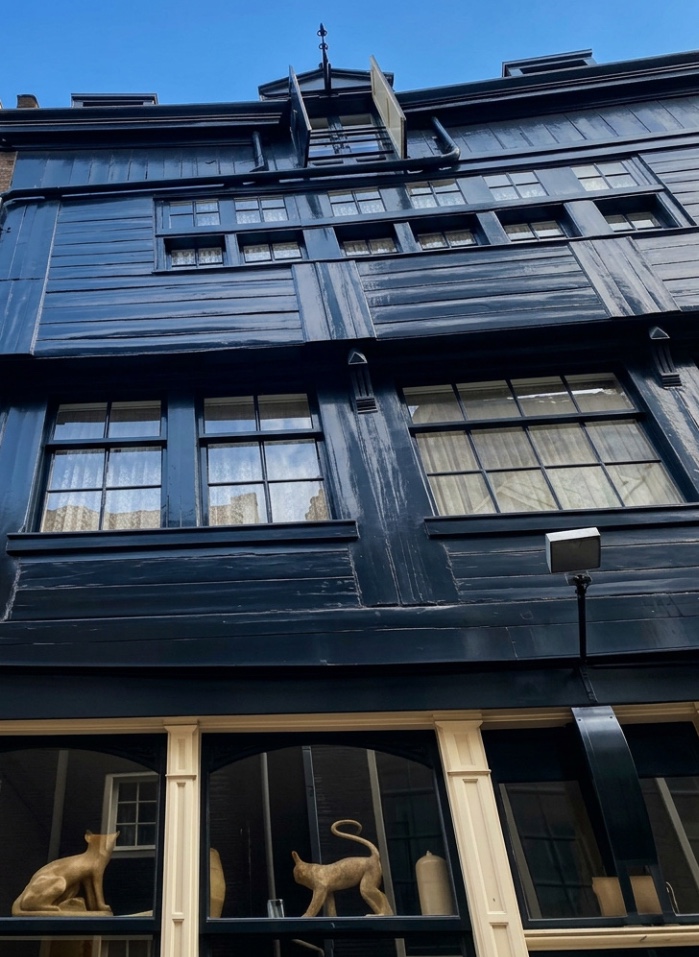
    Those first brick buildings even imitated their wooden predecessors and leaned out over the street – and not because of shoddy workmanship or gravity. Medieval timber houses had already jutted each story out over the one below to drip rainwater clear of the walls, and the brick buildings inherited that trick. The same forward wonkiness lets you hoist a beer barrel to the attic without punching out a window. Win-win.

    Brick-faced

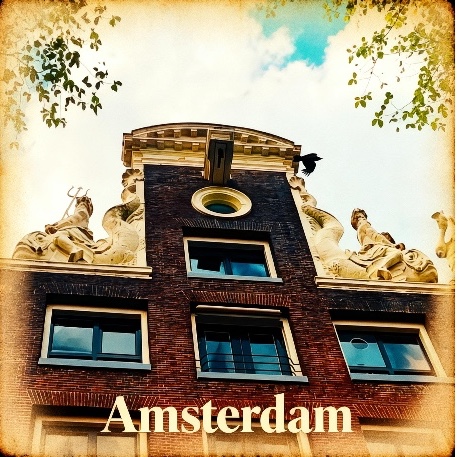
    Property along a canal was taxed by the width of your frontage, so merchants built narrow, deep and tall – then crowned the result with a fancy top gable to show off. And the shapes followed fashion: plain spout, stepped, scrolled neck, flouncy bell, and then the flat cornice that called the party off. Read them in order and you watch European taste dress up, get drunk, and sober up again.

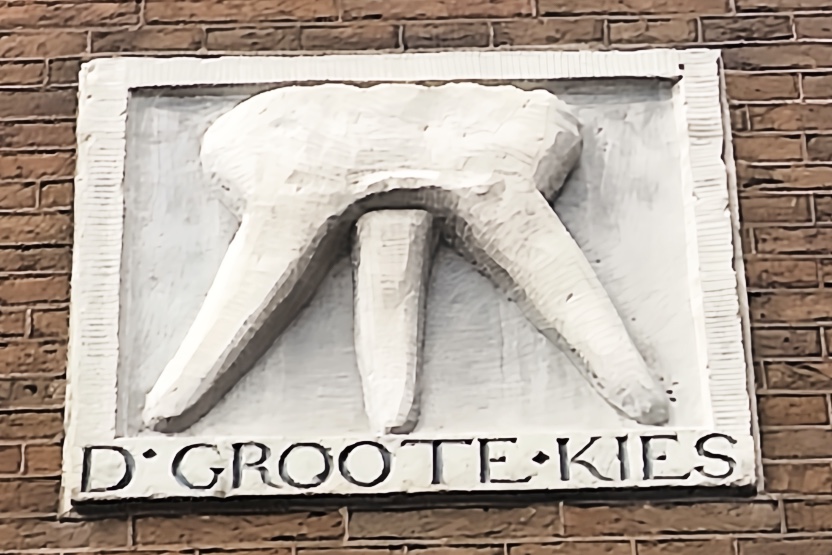
    A gable stone with a tooth advertising a dentist.

    While the gables up top were adorned with vases, masks, sea serpents, and such, the lower stretches were also pimped up – it’s a good moment to note that the Dutch word for gable, gevel, actually means the whole face of the building, not just the happy hat on top. That full face often came striped: red brick laced with white sandstone, which the Dutch deliciously call speklagen, or bacon layers. Set into the wall, you’d also often find a gevelsteen, a carved wall plaque advertising the trade of whoever lived there – a tooth, say, for the household that owned pliers and restraining straps. All this glam was useful in other ways: before the city numbered its houses in the 1700s, your gevel or the stone set into it was your address.

    But let’s stay real: all this goddam prettiness evolved from scamming the taxman.

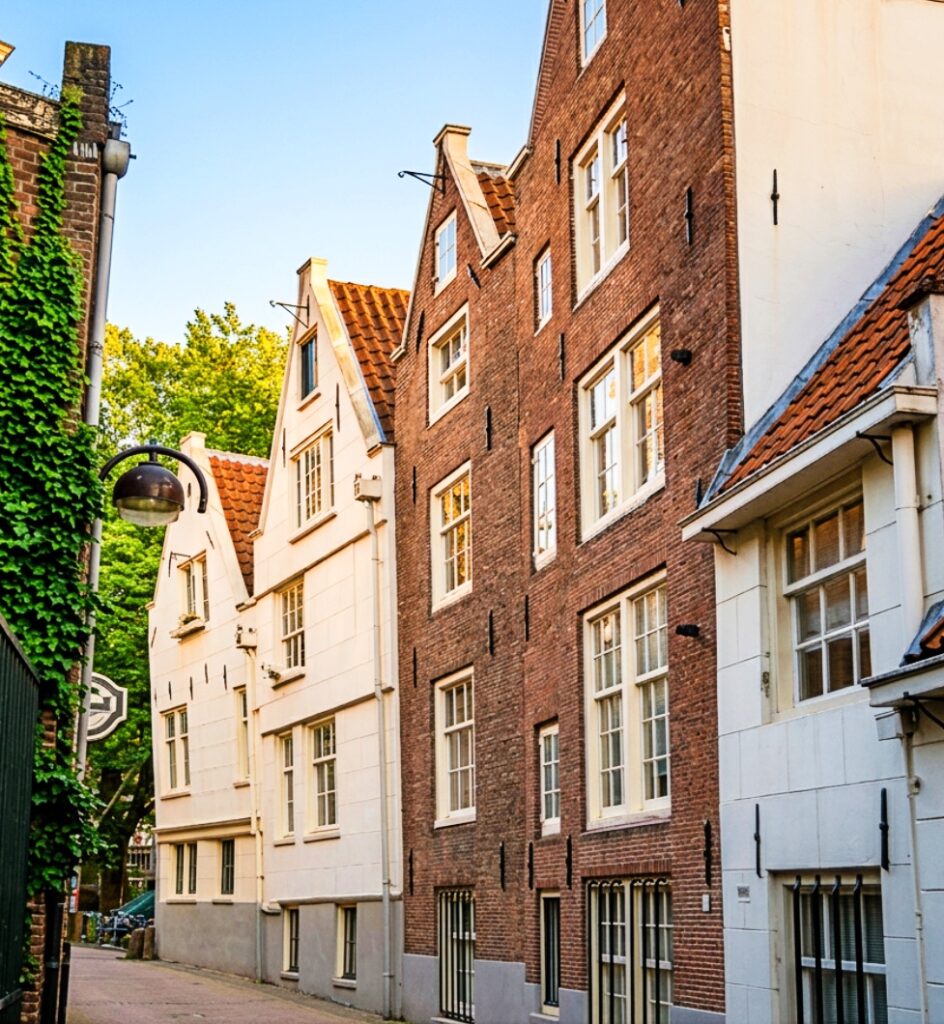
    A scenic street in Amsterdam with gabled houses.

    Not so golden

    When the money really poured in (spice trade, slave trade, plunder) in the 1600s, Amsterdam ran out of room and planned its own expansion. Three grand canals – Herengracht, Keizersgracht, Prinsengracht – were dug in a ring around the old town, with its own medieval heart now being the Red-Light District. 

    This Canal Ring may now be a UNESCO World Heritage site, but it basically began as a speculative property scheme sold off plot by plot to the newly rich. The prime real estate, the Golden Bend, is where the banks and deepest pockets lived: they could afford to be taxed on two or more plots of land.

    Beyond it, more modest neighbourhoods like the Jordaan went up to house workers and the stinkier industries.

    A gable of a canalside house.

    The blubbery soil still meant that more monumental buildings risked sinking back into the muck. Besides, this was a pragmatic merchant state. There was no royalty to project their monstrous egos through palaces and such nonsense. 

    One world wonder, many miracles

    There was one enormous exception to this lack of nonsense. On Dam Square, the city spoiled itself by building a monument to itself: a Town Hall so vast it was hailed as the eighth wonder of the world – and to keep it from sinking into the swamp, it drove 13,659 wooden piles into the muck beneath it. (Dutch schoolchildren remember the number by cheating: the days in a year, 365, with a 1 in front and a 9 on the end.) The merchants eventually handed it to a king, and it’s the Royal Palace today: an ego-monument standing on a forest hammered upside-down into a bog.

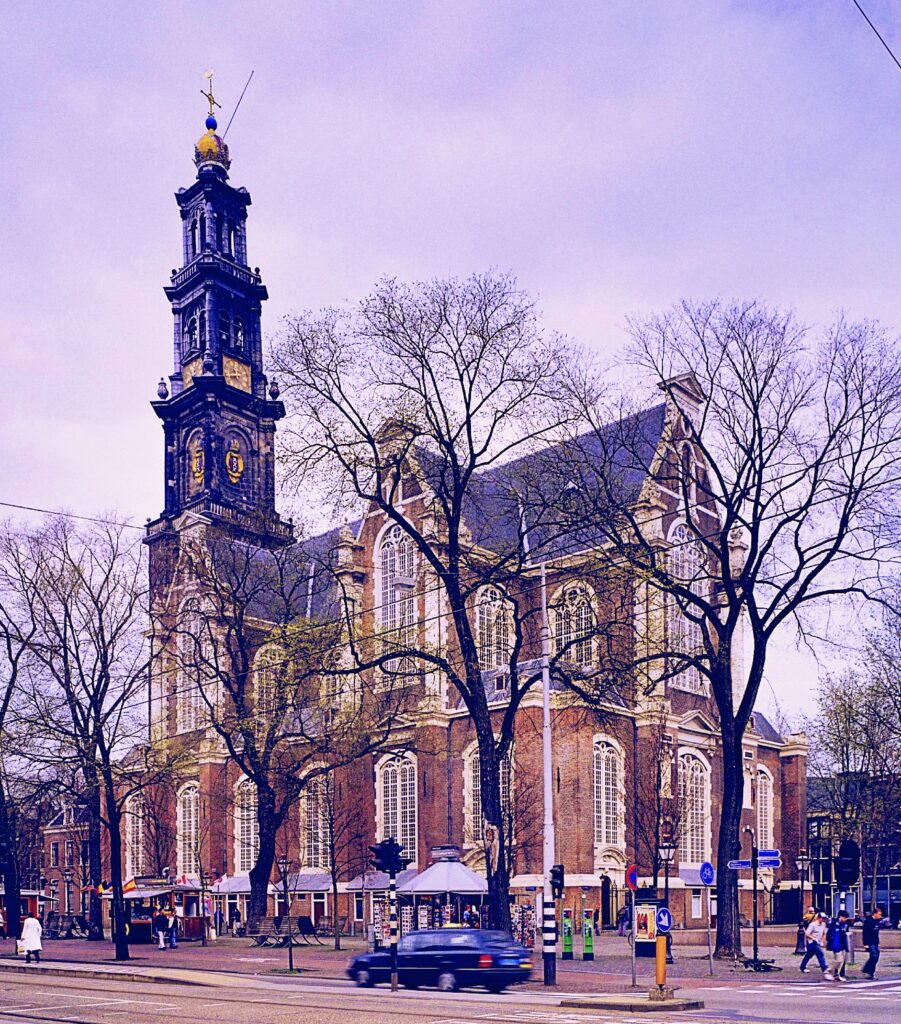
    Westertoren saying fuck you to the Catholics

    The churches have their own stories, with their massive organs and improbable miracles. Under Protestant rule, the Catholics weren’t allowed to worship in public – so they built hidden churches. Our Lord in the Attic, for instance, is a full chapel, folded invisibly into a canal house, hidden in plain sight. Meanwhile, the Protestant towers went up loud and proud. Today, these towering fuck-yous still define the city’s skyline.

    Not everyone had to hide. Amsterdam’s Sephardic Jews – refugees from the Inquisition and, by the boom years, one of the richest Jewish communities in Europe – built the largest synagogue on earth, right out in the open. The Esnoga (1675) is a vast brick hall modelled on Solomon’s Temple. It remains lit by candles to this day, and highlights the city’s famous tolerance: real, lucrative and entirely selective.

    Take that, you Protestant bastards

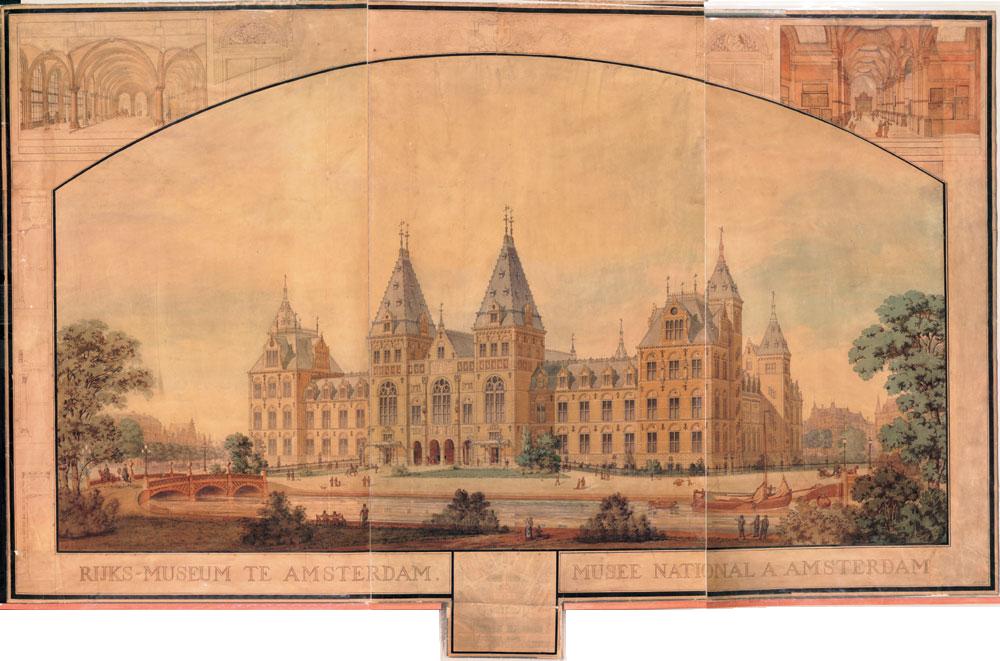
    The Rijksmuseum as architectural revenge, delivered ornately.

    Amsterdam’s second flowering came two centuries later, when a Catholic architect exacted his revenge on the skyline. Pierre Cuypers built the twinned Rijksmuseum and Centraal Station

    The Protestants were outraged. These buildings were too Gothic, too Catholic, too much. Wits nicknamed the museum “the Bishop’s Castle” and the station “the French Convent.” Both buildings were scandals fueled by bigotry. Now they’re postcards. 

    Centraal Station also walled the city off from the very water that had made it rich. That separation left Amsterdam Noord, across that water and the latest home for the city’s stinkier industries, largely ignored for over a century. 

    Architecture in an apron

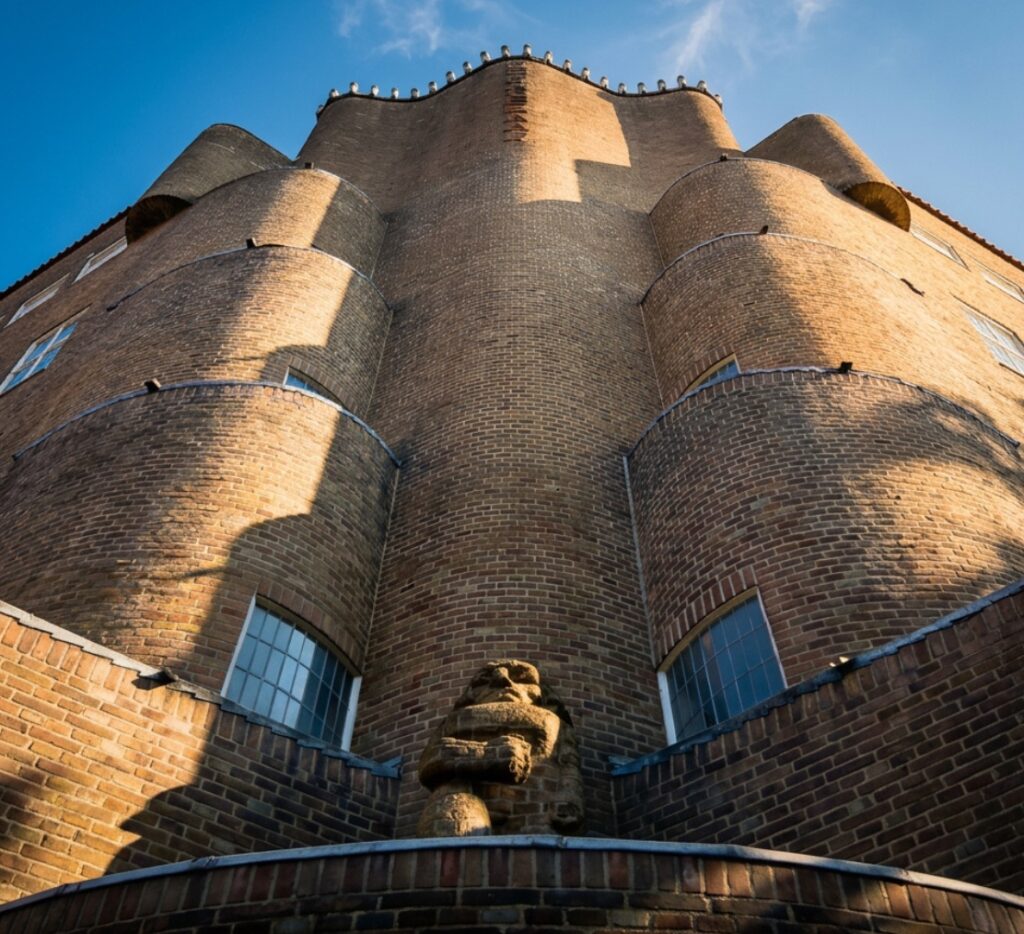
    A classic example Amsterdam School of architecture

    As the supporting poles grew longer and stronger, Amsterdam could indulge more. Berlage’s stock exchange helped inspire the Amsterdam School – aka ‘Apron Architecture’, because the brickwork billowed like fabric. Reinforced concrete – the emerging tech that rewired modern building everywhere – now provided the structure, freeing the brickwork for swoopy, expressive exteriors. Elsewhere, that freedom bought glass towers; here it bought social housing as a fever dream. Respect. 

    Then the Depression hit, and the need to cut corners turned the swoops into right angles. The school had to bow to pure functionalism – ‘New Building‘ – which was already stripping everything down to clean lines, glass and zero extras, especially after WWII, when there was a lot of building to do. 

    Building, then dynamiting utopia

    The most ambitious version of pure functionalism wasn’t a building but a vision. In 1935, Cornelis van Eesteren’s General Expansion Plan mapped out entire new districts to the west – the “Garden Cities” – and dictated where the city would grow for decades: light, air, and green, all by the numbers. It became a textbook of modern city planning before the neighbourhoods became textbook examples of urban decline. 

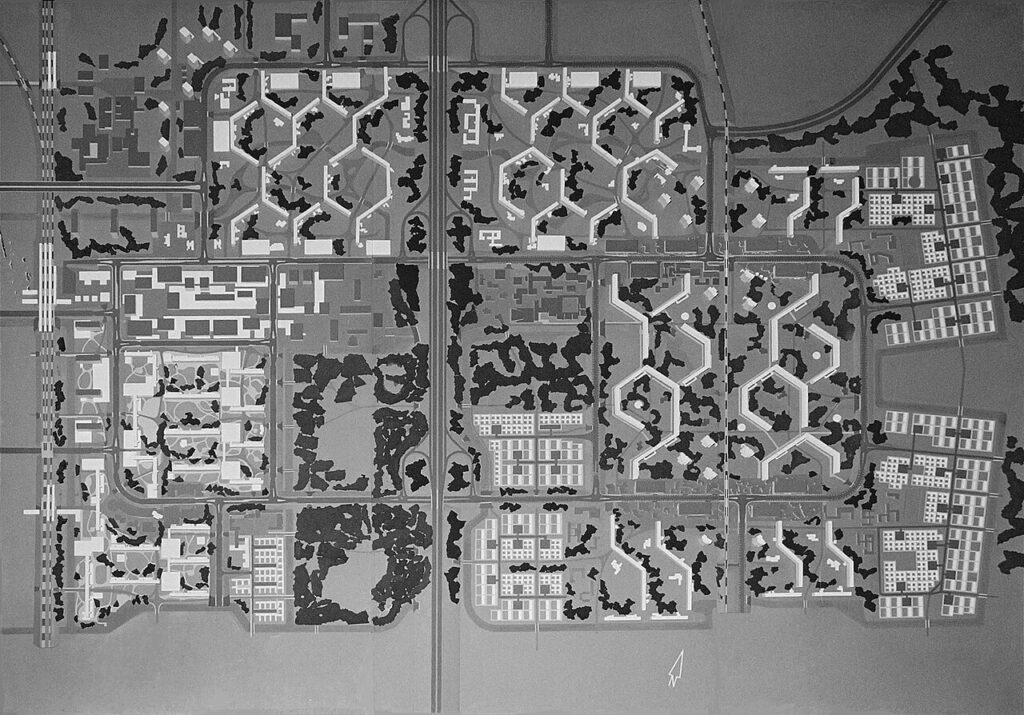
    Original drawing of the masterplan for the Bijlmer
    Urban plan for the Bijlmer by Siegfried Nassuth (1922-2005), photo by Joost Evers / Anefo. Under CC license.

    In the 1960s, the city pushed the plan’s logic to its limit with the Bijlmer – a honeycomb of identical high-rises set in green, meant to be the future, the same future that went up and then back down, from the dynamited towers of St. Louis to the Paris banlieues. Lesson learned: buildings can carry a dream and still fail miserably.

    And then it fell quiet

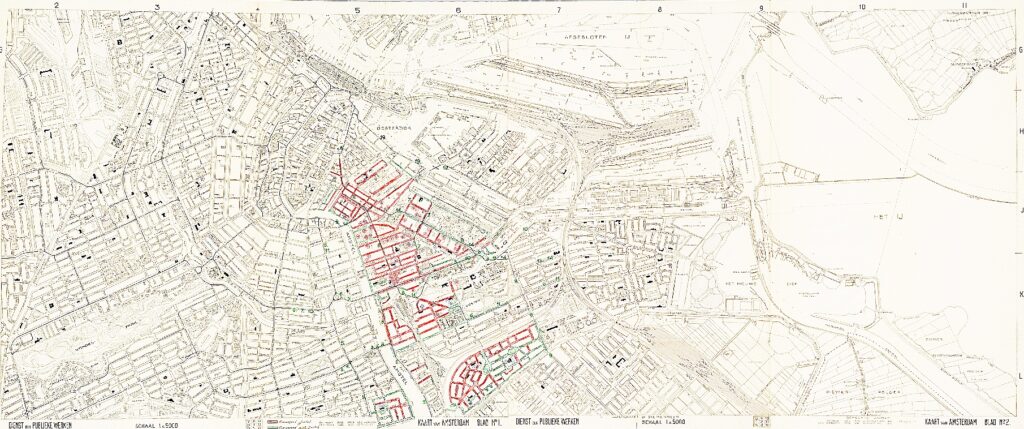
    The darkest demolition, though, wasn’t a failed dream or one of the city’s charming mistakes. It was a choice – made twice. First, the Jodenbuurt, the old Jewish quarter, was emptied by deportation: roughly three-quarters of the city’s 80,000 Jews were murdered, and never came home. Then, in the 1970s, the planners came for the buildings, bulldozing what was left to push a metro line through.

    A WWII map of "mainly Jewish" neighhourhoods in Amsterdam
    City Archive, Amsterdam. A public works map from 1942 that marked neighbourhoods that were “mainly” Jewish in red.

    The 1975 Nieuwmarkt riots – water cannon, tear gas, barricades – came too late to save the quarter, but they killed the broader plan: the motorway, the office towers and the metro lines meant to follow. The station beneath it is now hung with art remembering the houses that no longer stand above ground. The Esnoga survived the war; the neighbourhood didn’t survive the peace.

    Cities are good at paving over their biggest mistakes – and drowning out the past with their own noise. For instance…

    Overengineering, one of many Dutch diseases

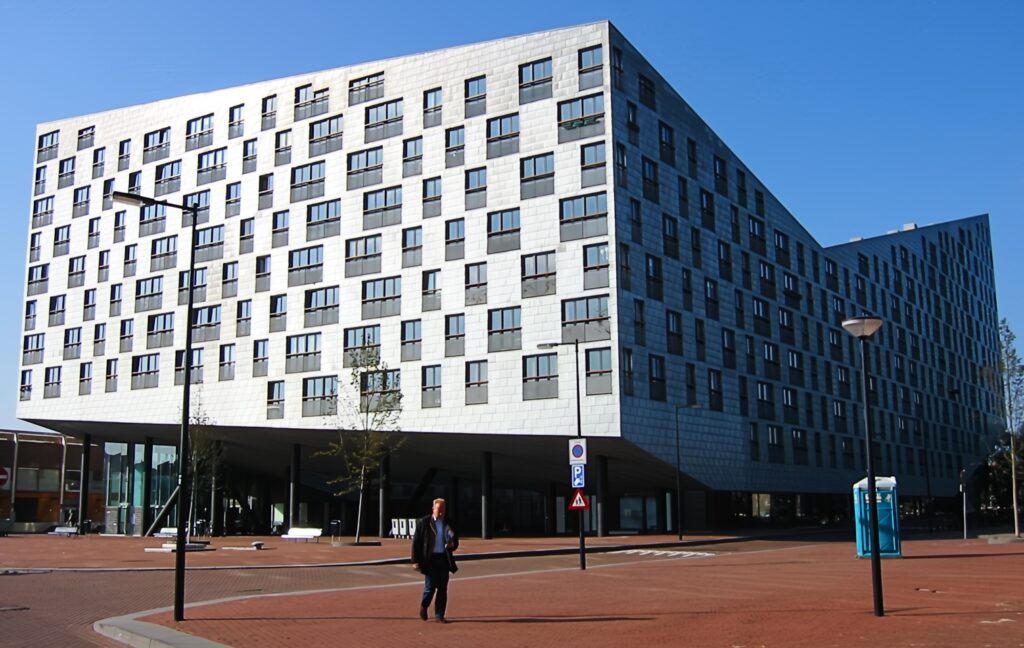
    By century’s end, showing off was definitely back. The Dutch pavilion at Hanover World Expo 2000 stacked ingredients such as dunes, forests and tulip fields like a “Dutch Big Mac” – the Netherlands as a theme park of itself.


    It was a sign of the SuperDutch times, with Amsterdam and its Eastern Docklands very much included as everyone sought to blur the boundaries between buildings and landscape, work and play, land and water. Everything was planned down to the centimeter, including nature.  

    Sometimes it worked; sometimes it resulted in a sleek designer-prison vibe. 

    Reduce, reuse, rezone

    It had always been cheaper to demolish and start from scratch – the Bijlmer lost half its high-rise grid barely a generation after it went up. But the city learned to think long-term, and turned to second acts. A building that began as the departure point for East European emigrants sailing to South America, then served as a wartime prison, reopened in 2004 as the Lloyd Hotel, complete with sleeping pods by Atelier van Lieshout – and in 2023 reinvented itself yet again as The Hoxton. Libraries became hotels. Drawbridge houses became hotels. A lot of buildings became hotels. So many pretty buildings, so many tourists.

    And round it goes…

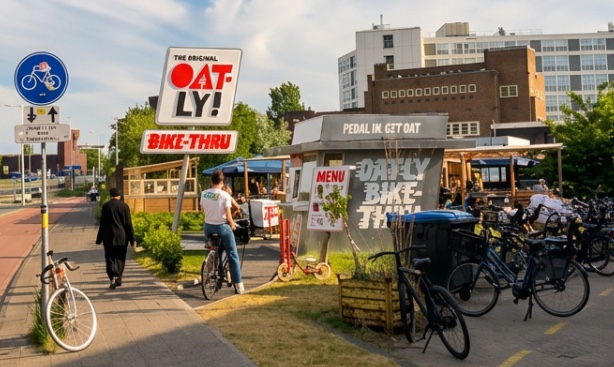
    Example of gentrification in Amsterdam Noord

    There are other stories… How a trading-house-turned-bank designed by a math-loving spiritualist was repurposed as the new City Archives. A shipyard is now a post-apocalyptic wonderland where squat culture and commerce commingle. And the surrounding Amsterdam Noord, once the part you avoided, is now an architectural hotspot, with the original working-class population being pushed out due to rising prices. 

    I can certainly go on. And on. About what made people build the way they did: the mud, the money, the lack of money, the fires, the fever dreams, the need to fix past mistakes, the need to make new mistakes. But this is how buildings stop being buildings and start being stories. Look up, look around, go wow, and raise a beer. I do it all the time: I may be jaded, but I still love this town. Never take a building, or a good story, for granted. 

    Read: ‘Writing about architecture  is like dancing about architecture

    Versions of some one-liners may have appeared earlier in Time Out, Wallpaper, Atlas Obscura and The Globe & Mail. 

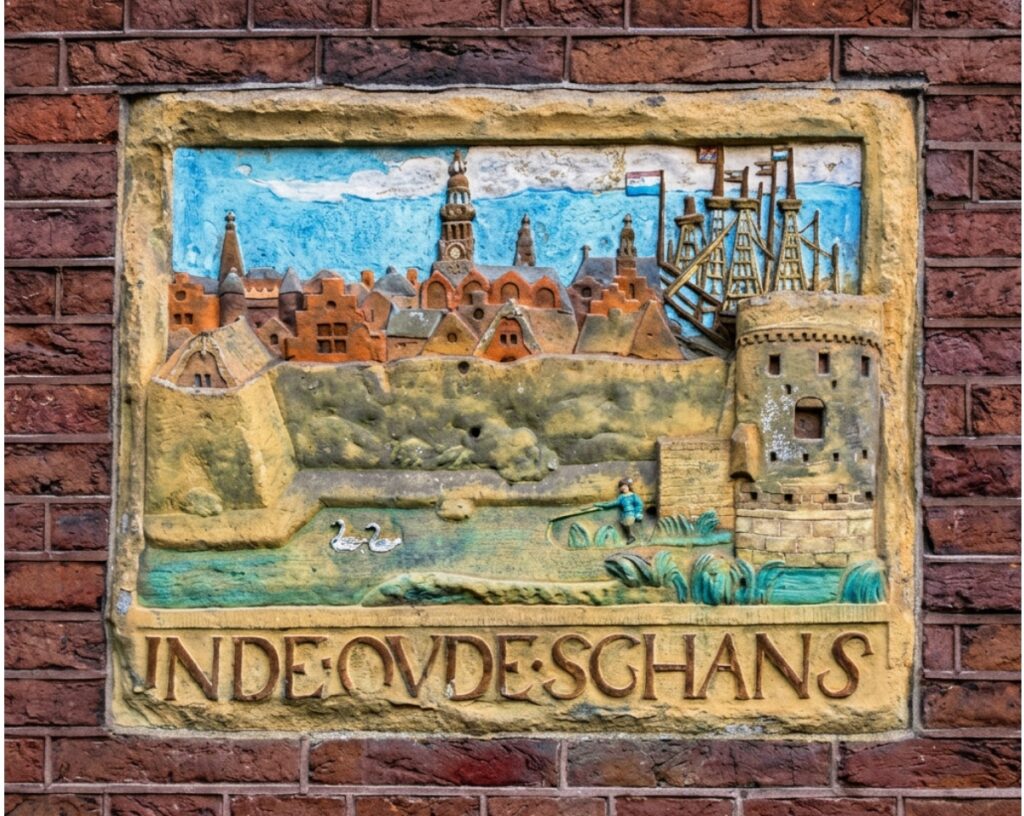
    A gablestone depicting Amsterdam rising from the bog.
  • Hotel Lloyd: a beautiful chaos

    Hotel Lloyd: a beautiful chaos

    A building that was once a claustrophobic hell-hole has been re-invented as hotel and ‘cultural embassy’ brimming over with Dutch design.

    By Steve Korver, 17-11-2004, cover feature, Amsterdam Weekly

    While I’m a fan of the Disneyland of modern Dutch architecture along the Oostelijke Handelskade and further east along the IJ, I have to admit that I also find the overall effect a bit clinical, and a smidgeon anal. Or maybe I just miss the coolest cultural squat on the planet, Vrieshuis Amerika, which was traumatically torn out this area in 1998.

    lloyd2

    Certainly this most constructed of ‘hoods could do with some more nature — or at least some more of the ‘natural’. The Vrieshuis, with its inflatable flowers on the fifth floor, its Wild West roller disco on the second floor and its clutch of caravan dwellers on the ground floor, was a truly hip artists’ paradise that grew organically from the chaos. It was natural. What this new neighbourhood needs is more chaos — both of the cultural and biological kind. Nature would then start occurring, um, more naturally.

    The ‘Dutch Model’ of design has been hyped around the globe — or at least in Japan and Scandinavia — for being both pragmatic and futuristic, and for its easygoing attitude to the boundaries between building, urban, and landscape planning. Still, to my mind it often misses the mark by regarding nature as an artificial construct that must be nurtured. Sure, Holland has the ultimate excuse: everything is fake here anyway. (‘No land, you say? Slap gelul! Hell, we’ll just reclaim some from a soggy marsh!’)

    Of course, the real can be faked. But faking the real still takes time. Nature, complex mistress of chaos that she is, is really too multi-dimensional to fake in the short term. The Amsterdamse Bos may have acquired an authentic forest vibe, but it only achieved this after many decades of wild growth.

    Some beehives have been installed on that stack of oversized tables towering above where the IJ-tram is due to run, but these won’t be enough to bring nature to eastern docklands. The area is desperate for that certain something that can’t be arranged even by the most cutting-edge urban planning on the planet. Maybe the area needs a farm, or a subsidiary of Artis Zoo. Perhaps inburgering a few more non-human fellow creatures will bring more balance to the humans who live and/or party there.

    Humanising a hell-hole
    Then again, the other side of the equation also needs attention. To this end the Lloyd Hotel, once a karmic hell-hole, is being turned into a happening hotel. And it’s a good sign that MVRDV, the architects who gave the world Pig City 2001, a skyscraper for pig breeding, and Atelier van Lieshout, the artist/designer responsible for Pioneer Set, a mobile farm, are involved in the hotel’s re-invention. With such influences, there’s a good chance that the area’s also a step closer to humanisation.

    I ask Suzanne Oxenaar, one of the project’s jump-starters and the person responsible for the hotel’s unique Cultural Embassy (more later), what the chances were that the hotel’s backyard might become another Pioneer Set complete with blissed-out hogs. ‘I certainly wouldn’t discount the possibility,’ she says, her eyes twinkling. ‘In fact, Joep [Van Lieshout] has already suggested it.’

    I say bring on the manure. It may be just what this over-shiny ‘hood needs.

    When they began transforming the Lloyd, there was still a lot of bad voodoo in the hotel’s history to transcend. Built in 1921, it began as a European emigrants’ hotel, and could accommodate up to 900 guests at a time — usually Eastern Europeans on route to becoming South Americans. They would be checked in at the ontsmettingsgebouw (‘decontamination building’) across the street, where now the excellent cafe/gallery Cantine is located. There, guests would be given a righteous hosing down before going, via an underground tunnel, to the hotel proper.

    ‘The concept of what a “guest” is has changed many time in this building,’ says Oxenaar. Obviously this is an understatement.

    Later during the Occupation, the Germans re-zoned Lloyds as a jail, where people arrested during the February Strike were kept. After the war it retained this function, to ‘host’ collaborators and members of the NSB. But the Lloyd’s history was probably at its darkest between 1964 and 1989, when it served as Amsterdam’s premier youth prison. (The ‘New Lloyd’ in Amsterdam-Zuidoost has now taken over this function.) The old Lloyd began its healing process when it became a living/working space for artists in the early 1990s, which lasted until 2001.

    The ‘old’ Lloyd isn’t just another ‘design hotel’, or an attempt to copy the success of New York’s Chelsea Hotel or even of Rotterdam’s Hotel New York (though the latter does share the Lloyd’s immigration-related past and designer present). The birth of the new Lloyd Hotel was in fact — yes, indeed — an organic, complex and slow process that has involved many movers and shakers. (Some of them will be mentioned below, but many won’t: there are a lot of them.)

    Transforming the place from a youth prison into a hotel and ‘cultural embassy’ has, in fact, taken over eight years. It began with Oxenaar and a certain Otto Nan, both of whom have impeccable underground culture credentials. Oxenaar was a co-founder of the Supperclub (then a true vortex of artistic interaction, unlike the commercial operation it is today) and an organiser of international art exhibits. She has taken responsibility for the hotel’s Cultural Embassy and acts as the hotel’s most enthusiastic propagandist. Nan, the hotel’s general director studied art history and then made a name organising events and shows, including the Wild West roller disco and ‘cultureel pretpark‘ in Vrieshuis Amerika. He describes himself as a ‘financial autodidact’. (Cool business card!)

    In 1996 Oxenaar and Nan took part in a city-sponsored competition for the development of the hotel, which was then a rotting hulk of a bad-vibed building and — to their own surprise — won. But the banks they approached were wimp-asses, and it took the duo a while to find the money needed for the redevelopment. Eventually Woonstichting de Key agreed to fund it, and is now the official owner.

    ‘It was never the idea to turn it into a hip hotel or a hip restaurant, like Supperclub.’ Oxenaar says. ‘We were interested in creating space and freedom — to create a space where people could do what they wanted. Only then did we think that it should be a hotel.’

    As an organiser of international art exhibitions, Oxenaar has observed the internationalisation of the global arts scene and the ‘eternal emigration’, as she calls it, of its participants.

    ‘This new concept had to be even looser than the Supperclub, which was restricted by the hour when food began being served,’ she says. ‘That’s why everything is open 24/7 here. No deadlines. And once we embraced the idea of a hotel, we also realized that existing hotels don’t take advantage of guests with something to share. Hotels are generally just too formal for that.’

    This is why they’re leaving as much space as possible in the rooms for work, she says. This includes empty walls, bathrooms that fold away out of view, and extra furnishings left in the hall that guests can take to use as they need them. There will also be a kitchen where guests can cook. ‘So they can be “hosts” to their own guests,’ says Oxenaar.

    Cooking with Culture
    The Cultural Embassy, which reflects the spirit of the new Lloyd concept, is located on four open balconies hanging above the 24-hour Snel restaurant. (The other, a non-24-hour, dinner restaurant, is posher and called Sloom. Both, local foodies might be interested to know, are in the very capable hands of Liesbeth Mijnlieff, a co-owner of Cafe-Restaurant Amsterdam.) These spaces are already buckling under the weight of donations: a whole library of art books from the Rietveld Academy, and some nice and bulky Berlage- and Bazel- era furniture from the Instituut voor Sociaal Geschiedenis that harkens back to the era when the Lloyd was originally built. Guests can wheel a selection of books to their room on a trolley especially designed by the artist Suchan Kinoshita. They can also make their own donations — whether it is a painting or a book.

    While most hotels can point you to the canal cruises, few are hip enough to point you towards new artistic Muses. As a new Uitbureau point, Lloyds can arrange tickets 24/7 to any event which a guest may have discovered on the advice of a Lloyd employee (or, um, from the latest issue of Amsterdam Weekly). Guests can also get advice on how to make the best use of their time. Oxenaar recalls how staff helped a Shanghai gallery owner to find her way around the local arts scene. On another occasion, a convention of mystery writers ended up reading ghost stories to each other. She also recalls the unique bonding that occurred after a random public encounter between a group of African lawyers and a group of art students from the Sandberg Institute.

    Indeed, variety is the spice of life. And at the Lloyd that variety also occurs on wallet level.

    ‘We quickly realized that money is very relative for the international- and culture- oriented traveller,’ says Oxenaar. ‘Not all talents have lots of money.’

    I nod vigorously at this very valid observation.

    ‘That’s why we offer rooms covering the full range from one to five stars,’ she adds. This refreshing non-elitist attitude–a rarity in the arts world, if I may say so, my darlings–is also seen in the arrangement of the rooms, which has one-star rooms alongside five-star ones. The hotel offices are set up as an open ‘flexispace’.

    Dancing around Architecture
    MVRDV’s involvement from early on was also a good move. The design bureau is famous for creating interesting spaces where few others could, or dared to. Take their senior citizen home Oklahoma (1997) in Amsterdam, which ingeniously provided the required number of living units on a limited ground space by cantilevering rooms off the side of building — to wacky effect. Even wackier was the way the bureau helped to put Dutch architecture back on the map at the Hanover World Expo 2000 with their Dutch Big Mac, which had various entertaining (but still functional) elements like watermills and windmills on the roof for generating electricity, a theatre on the fourth floor, an oak forest on the third floor, flowers on the second floor, and a few dunes on the first floor, along with some cafes and shops. In essence it was just a very posh Vrieshuis Amerika.

    MVRDV are so interesting that no one could possibly hold it against them that they are reputed to be Brad Pitt’s favourite architectural bureau. Like that other Dutch architecture biggie, Rem Koolhaas, they drape descriptions of their buildings in dense rhetoric. How about this gem from their state-of-the-art website, for instance? ‘A pragmatic transcription in a spatial matrix consisting of the superposition of the diagrams.’ Anyone know what that means?

    But I can accept not knowing what it means. After all, recently graduated architecture students need something to talk about while awaiting their first real-life commissions. (By the way, Brad, if you have any tips on decoding the dense poetics of MVRDV’s ‘design philosophy’, as outlined on their website, please get in touch.)

    Rhetoric aside, MVRDV are cool. You have to respect any band of merry builders who plan to construct a grassy mountain over London’s Serpentine Gallery this summer. That ‘pavilion’ might possibly even outdo the beautiful one built there last summer by Oscar Niemeyer, the great Brazilian architect and curve connoisseur. (Niemeyer claims that he picked up his own sense of organic shapes on the beaches of Rio.)

    Back to Lloyds… MVRDV took over the Lloyd’s renovation, and they began by ripping off the roof to let in some much-needed light. Then they tore a hole right down to the floor to allow more light into the building — as well as the space for the 120 rooms, which cover the full democratic spectrum of possibility. The boundary between the private and the social is generally loosely defined in all the remaining nooks and crannies of the hotel, which allows guests to use them according to their own needs at a particular time. In general the architects appear to have realised the building’s karmic desire for release, so that visitors are drawn ever upward…

    I’m starting to sound like a ‘design philosopher’ myself.   But anyway, a building that was once a claustrophobic hell-hole with a questionable history has been opened up. The non-grim elements of the original building — stained glass windows, tiled walls, exposed timbers, and raggedly pored concrete floors — have been retained. Some prison cells have been recycled for open-concept linen storage. The main idea, says Oxenaar, was to ‘use the past and make it visible and accessible for inspiration.’

    A showcase of design
    The Atelier van Lieshout — whose inspired career includes the creation of AVL-Ville, a ‘free state’ complete with shit-happy hogs and its own currency in the port of Rotterdam during 2001 — and other hotshot designers like Bureau Lakenvelder, Richard Hutten, Marcel Wanders and Hella Jongerius have taken on the hotel’s interiors. And the result is truly a party pack of rooms with plenty of examples of the functional yet witty style that has made Dutch Design so world famous within the Netherlands. During the official opening last week I enjoyed freaking out visitors by pretending to violently rip a Christoph Seyferth lamp out of the wall. It was actually attached by magnet. Teehee. That’s exactly the sort of interactive feature that I crave in my hotels.

    Curiously, the different rooms are best described through their bathrooms. Some bathrooms are shared, some fold away behind doors, some have translucent walls that act as the hotel room’s ambient light, some are merely an open shower in the middle of the hotel room, and yet others are wholly customised from polyester resin (the smell of which still hangs in the air).

    The big theory behind this hotel remains the idea that everything is for everybody. Guests will certainly love it. But will Amsterdammers? That remains to be seen. Personally, I think that Amsterdammers should hold back on the smart-ass commentaar for a while and see how things evolve. Let’s just give the folks behind Hotel Lloyd a couple of years to sort out all the unavoidable kinderziektes. After all, the Amsterdamse Bos didn’t grow in a day.

  • Amateurism, the fresh maker

    Amateurism, the fresh maker

    Professional architects, landscape architects and urban designers go ‘amateur’. Can it save our city from being scrubbed to death? Two new experts take us to the streets to look for inspirational amateurism in our own backyard.

    By Steve Korver, 06-03-2008, cover feature, Amsterdam Weekly.

    Amateurism is everywhere. Just look at last week’s headlines. The Rijksmuseum will now not open until 2013—seven years later than planned and likely 88 million euros over the currently available budget. Meanwhile, the global media continues to pump up the impending release of an anti-Muslim movie being made by a local amateur film-maker.

    AmsterdamWeekly_Issue10_6Ma

    But amateurism can also be a good thing: as inspiration for ‘professionals’ and a potential means to quirk up and give identity to urban spaces.

    Since January, the Architecture Academy on Waterlooplein has been under the spell of amateurism. This year’s artist-in-residence, Erik Kessels, creative director of the communications agency KesselsKramer, has been celebrating amateurism by organising workshops, street actions and an exhibition. There are also weekly lectures that have included the likes of Julian Germain, who has worked with Brazilian street children to create huge walls of photography, and Marti Guixe, a ‘product designer who hates objects’. This Thursday, Dori Hadar, a criminal investigator and junk collector from Washington DC, will talk about discovering the homemade 50-album oeuvre, all made of cardboard, of imaginary soul superstar Mingering Mike.

    KesselsKramer has been behind some of the quirkier ad campaigns of the last decade, such as the one that promoted Hans Brinker Budget Hotel with, ‘It Can’t Get Any Worse. But We’ll Do Our Best’. But KesselsKramer has also produced the film The Other Final that documented the match between Bhutan and Montserrat, the two lowest ranking football teams in the world, and published several books on amateur photography.

    In the introduction to the forthcoming book Amateurism due out later this month, Kessels writes: ‘In Wikipedia (one of the greatest non-professional projects ever) we see the word [amateur] has a French root, meaning “love of”. And that is the crux for me. Amateurs have a passion for what they do that is mostly unaffected by the need for recognition (financial or otherwise). It is a cliche, but the work is its own reward. Their enthusiasm results in styles and ways of seeing usually absent in the creations of their professional peers.’

    Applied amateurism
    Martijn Al, working as a professional landscape architect for CH&Partners in Den Haag while completing his Masters at the academy, reassures me that no one in his firm has ever considered approaching the building of foundations in an amateuristic way. While participating in the week-long Amateurism Workshop in January, Al’s own project had him working with Design Politie and architect Duzan Doepel to make a typographic, yet amateuristic, political intervention in the city.

    ‘Since it had to be political, I was inspired by the fact that the Netherlands is one of the countries with the least amount of private places in the world—with the most cameras and the most tapped phone calls, etcetera. I started to see the cameras everywhere: in train stations, by bank machines and on squares and streets. And I learned that there were only two rules: the recorded images could not be made public, and these cameras had to be visible. But what’s visible? People just don’t notice them. So we made a cardboard cut-out that said ‘Watch Your Step’, bought some rice at the Chinese supermarket on Nieuwmarkt and then dumped the rice into the cut-out on the street in front of the store’s camera.’ The results were an elegant way of drawing attention to the many city cameras recording our every move. (Of course, a professional activist would have just covered the lens with spray paint.) And Al was inspired: ‘Usually as architects, we are just busy with paper and plans and then the building companies do the actual work. Now we were doing something in practice.’

    But besides enriching the streetscape temporarily, can applied amateurism help in stemming the continued trend of vertrutting—frumpification—in Amsterdam? ‘This city is indeed turning more and more into an open air museum, but on the other hand, it’s the country’s calling card. So there is a positive side to it,’ says Al, who lives in Haarlem.

    ‘But you do lose a sense of identity,’ he adds, as we take a stroll along Nieuwe Herengracht between Weesperstraat and the Amstel. ‘Things are changing. Ten or fifteen years ago, the trend was that public spaces should be as empty as possible so they can be used in as many ways as possible. Now the trend is to green things up.’ Al laughs as he points out an old Oma bicycle pimped up with plastic vines and flowers. ‘And there are many different ways you can green things up!’ ‘Landscape architects have, in a way, already applied amateurism into common practice. We are not independent artists. We have to talk to the clients and the people who are going to be using these spaces. And as “amateurs”, these users are a very valuable resource. If you notice that a lot of residents already have their own tiny gardens, you can fit that into the planning.’

    And indeed, as we reach the Amstel, tiny allotments are currently being built into the sidewalks in front of the houses. As we reach the bridge, Al also points out a houseboat with a floating wild garden providing contrast to the newly laid cobblestone. It’s nice, green and chaotic, adding amateuristic life to some highly professional surroundings.

    Prinseneiland, amateur paradise?
    Lada Hrsak is a professional architect who has done everything from redesigning an Amsterdam houseboat to working on the heralded new Dutch embassy in Addis Abeba, Ethiopia. She’s also employed as a teacher of design and concepts at the academy and took part in the workshop. She was paired up with stylist Patrick Moonen to work out amateur concepts in fashion, resulting in feather boas made from Albert Heijn plastic bags and suits made from financial pages.

    ‘The workshops were a piss-take in a way,’ says Hrsak, ‘but a lot of fun. More rude and funny than cynical. And in KesselsKramer’s work you see the influence of amateurism from day one. In fact, the rest of Dutch design has this same bottom-up approach. That’s why it’s so renowned for being fresh and witty. But you still need a professional to “clean it up”.’

    Hrsak sees amateurism as a tool: ‘It’s about the commercial-free devotion to the thing you’re doing. It’s about obsessiveness—or perhaps “passion” is the better word.’

    She thinks some architectural ‘masterpieces’ have been produced through amateur efforts, such as a palace of stone built by French postman, Ferdinand Cheval (1836-1924), who spent 33 years building his ‘ideal palace’ from rocks that he collected while doing his mail route.

    We are walking around Prinseneiland. While the beautiful island has undergone a lot of new development, it still hasn’t lost its funky vibe, though the same cannot be said for large sections of the neighbouring Jordaan.

    ‘Why this area works is because of the diversity of styles,’ Hrsak says. ‘Not everything is of one grain. Of course all the houseboats help. And while there are modern buildings now here, you also have murals, the children’s farm, and this is just beautiful of course.’

    She has led me to a ground floor apartment across from cafe Blaauw Hoofd on Blokmakerstraat. The front porch has a double car seat, two birch branch lamps and the background is a large print of Hieronymus Bosch’s Garden of Early Delights. Could this garden be translated on a larger scale elsewhere?

    ‘I’ll have to get back to you on that one,’ she laughs. ‘Now the emphasis is too much on building at high speed and achieving the most square meters. It’s all about haalbaarheid [practicality]. And if you leave space for unclarity—where the users can actually fill it themselves—that makes developers nervous. The design challenge is to generate development and make buildings good enough to bear imperfections. But on a small scale, such as here, it’s still possible.’

    ‘And remember, it’s about allowing freshness. It doesn’t mean we should cover our buildings and cities with all kinds of junk.’ Too bad. There goes the idea of suggesting the immediate reopening of the Rijksmuseum as it is now, and just covering it with garden gnomes.